
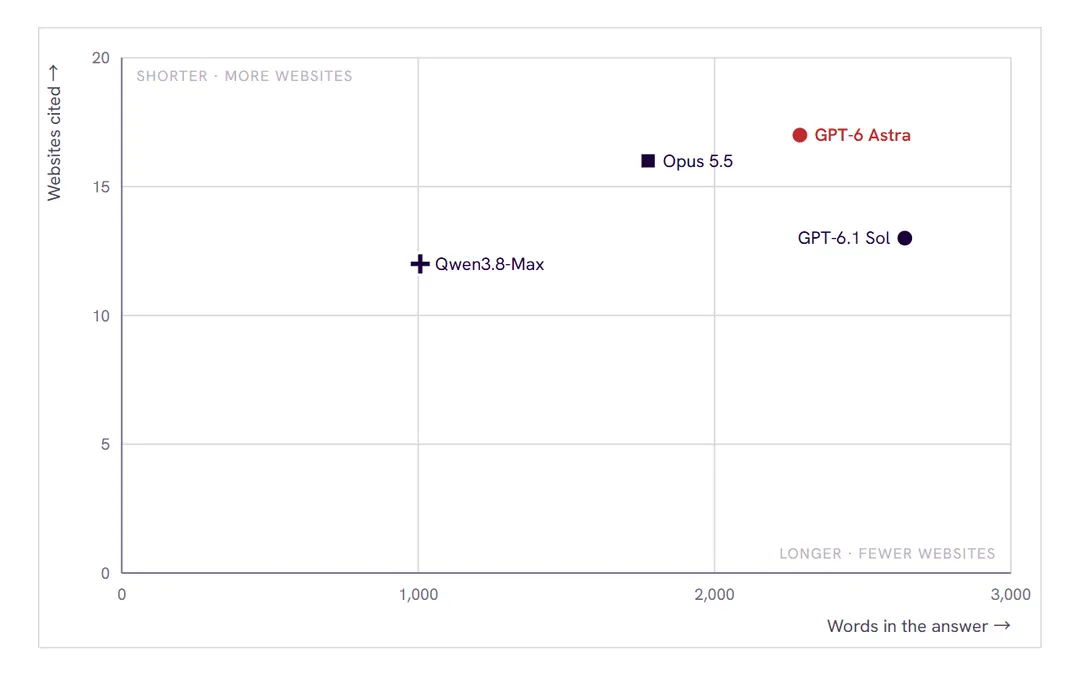
GPT-6 Astra at Max, asked 6 Oct 2026
One answer from the comparison, shown in full as the model produced it on 6 October 2026. Nothing is edited. Its 19 cited links have not been opened, so this page does not say whether the pages back what it wrote.
My recommendation is to build around three purchasing needs: fewer preparation steps, predictable cost per usable serving, and reliable replenishment. For a manufacturer with frozen or retort capabilities, I would first test products for supermarket delicatessens, foodservice wholesalers, and institutional kitchens.
The evidence supports these problems and shows buyers spending money to solve them. It does not establish that any particular product category is underserved. Your manufacturing capabilities, country of origin, and delivered costs will determine where you can win.
I researched current Japanese surveys, companies’ operating disclosures, purchasing specifications, and adoption cases, prioritizing evidence available by 6 October 2026.
The clearest evidence of need is operational.
| Purchasing pressure | Evidence | What it means for your product line |
|---|---|---|
| Keep food service running despite staffing constraints | In July 2026, 57.7% of surveyed restaurant companies reported insufficient nonregular staff. This had improved by 4.1 percentage points from a year earlier, but remained the highest industry figure. Teikoku Databank. tdb.co.jp | Products should remove identifiable tasks: washing, peeling, cutting, weighing, cooking, or complicated finishing. |
| Protect economics when raising selling prices is difficult | Japan Finance Corporation’s July 2026 food-industry survey reported a purchasing-price diffusion index of +82.8, selling-price index of +55.2, and sales-volume index of −17.3. These measure the balance of responses, not percentage changes in prices or volumes. September 2026 release. jfc.go.jp | Demonstrate cost per finished serving, including preparation and losses. A low factory price alone is insufficient. |
| Secure consistent quantities and quality | Among 1,876 respondents to a January 2026 question about the purposes of producer partnerships, 78.6% selected stable quantities, 59.0% stable quality, and 34.9% required varieties/specifications. The survey primarily covered businesses handling domestic agricultural products. JFC survey, p. 6. jfc.go.jp | Consistency, specifications, and supply arrangements can be part of the product’s value. |
| Avoid inventory becoming commercially unusable | Japan’s Ministry of Agriculture describes the commercial practice of requiring delivery within the first third of shelf life. By October 2025, 377 retailers had relaxed or planned to relax delivery deadlines, while 393 manufacturers were extending shelf life. MAFF. maff.go.jp | Design around remaining shelf life at the buyer’s warehouse, replenishment frequency, and case size. |
My ranking below is a priority order for validation, based on problem severity, observable purchasing behavior, and the scope for product adaptation.
| Priority | Opportunity | Product direction | Main commercial obstacle |
|---|---|---|---|
| 1 | Supermarket deli and foodservice preparation | Prepared components that remove a kitchen task | Established suppliers and in-house production |
| 2 | Consistent vegetable supply and usable yield | Cut, cooked, portioned, or individually frozen vegetables | Commodity competition and freight |
| 3 | Care-facility meal continuity | Reheatable main dishes and sides | Nutritional requirements and service complexity |
| 4 | Affordable retail purchases | Small, usable portions at an acceptable selling price | Packaging cost and shelf productivity |
| 5 | Explicit school-meal specifications | Products meeting narrowly defined ingredient requirements | Domestic-origin restrictions and qualification |
| 6 | Ingredient-cost reformulation | Bakery and confectionery components with better economics | Technical competition and taste acceptance |
For supermarket deli and foodservice products, the strongest opportunity is supplying a component that makes an existing menu easier to produce.
Heiwado reports that increasing products prepared through its subsidiary’s processing and deli centers helped restrain store-level labor hours and broaden the range of meals available at smaller supermarkets. This is evidence of an operational change already being implemented. Heiwado results, p. 4. heiwado.jp
Kobe Bussan’s June 2026 presentation likewise identifies introducing Makiya’s externally prepared products into its Chisouna deli business and joint procurement to reduce purchasing costs as objectives of their alliance. Kobe Bussan presentation, p. 18. kobebussan.co.jp
Product hypotheses worth testing:
- Cooked vegetable sides requiring only reheating and portioning.
- Prepared fillings or toppings for rice bowls, noodles, sandwiches, or bakery products.
- A lightly seasoned base that the buyer can finish with its own sauce.
- Consistently portioned items that remove weighing and cutting.
The first question should be: “Which current item takes disproportionate preparation time?” Then develop against that item’s existing price, taste, equipment, and serving requirements.
Hotels offer a related, narrower entry point. In a supplier-published interview, Hotel Prizm describes replacing a more complicated breakfast offering with a wider bread selection, simplifying preparation and running breakfast with one staff member. It also reports lower food costs. This is a named adoption case, although the results are self-reported. Hotel Prizm case study. stylebread.com
My preferred initial route would be a regional foodservice wholesaler or meal manufacturer, with trials conducted in the kitchen using the product. The large-chain examples demonstrate demand, but their existing production infrastructure also makes them demanding competitors and customers.
For vegetables, there is particularly useful evidence that buyers purchase imports for supply stability and preparation convenience.
The Agriculture & Livestock Industries Corporation reports that July 2026 frozen-vegetable imports reached 117,642 tonnes, up 4% year on year. It attributes increased frozen-broccoli imports partly to high domestic prices, convenient preparation, and stable imported-product pricing. ALIC, October 2026 report. vegetable.alic.go.jp
The same report provides a useful counterexample: cabbage imports fell as domestic prices stabilized. A product that succeeds during a shortage may lose its advantage when domestic supply recovers. ALIC. vegetable.alic.go.jp
I would therefore investigate a particular preparation problem, rather than select vegetables solely because imports are growing:
| Proposed adaptation | Buyer benefit to test |
|---|---|
| Consistent cut size | More predictable cooking and portioning |
| Low drip loss after thawing | Better usable yield |
| Individual freezing | Ability to use only the required quantity |
| Specified stem-to-floret ratio | More predictable appearance and edible portion |
| Cooked or blanched to a defined endpoint | Fewer preparation steps |
| Documented alternative supply origins | Reduced dependence on one harvest |
These are proposed development criteria, not universal Japanese requirements. The opportunity is strongest where you can outperform the incumbent on usable yield, preparation time, consistency, or availability. Generic frozen vegetables already have extensive incumbent coverage, including Nichirei’s range of products supplied from multiple countries. Nichirei commercial products. 冷凍食品・冷凍野菜はニチレイフーズ
For care facilities, the need can be more urgent, but the product and service requirements are more demanding.
A government-published case study describes the Azalea care facility adopting fully prepared main dishes and sides, reheating them with existing equipment, and preparing rice and soup locally. Kitchen staffing requirements fell by approximately four to five people. Crucially, the facility reported no major overall cost difference before and after adoption; the benefits included consistent service and easier staffing. Government case study, PDF pp. 22–23. city.machida.tokyo.jp
That suggests a strong purchasing proposition: the facility can continue serving the required meals with the people available.
Potential products include reheatable sides, portioned protein dishes, and components that retain an acceptable texture after reheating. I would enter through an established caterer or meal supplier, beginning with ordinary meal components. Specialized swallowing diets require a separate level of specification and validation.
For retail products, the more defensible adaptation is often portion and price architecture.
Maxvalu Tokai explicitly reports expanding products suitable for eating or using up in small quantities, alongside its Topvalu range, in response to consumers’ economy-minded purchasing. Maxvalu Tokai results, p. 2. mv-tokai.co.jp
AEON’s April 2026 announcement provides a concrete example: it expanded individual yakitori sales after observing demand for buying small amounts and selecting different items for different family members. It also describes using breast meat to improve raw-material utilization and cost efficiency. AEON announcement. イオン株式会社のプレスリリース
For an existing snack, sauce, dessert, or ready-meal line, I would test:
- A smaller pack with a genuinely lower purchase price.
- Separately usable portions that reduce unfinished leftovers.
- A pack sized for one clearly defined eating occasion.
- A retailer-exclusive version, where the buyer has sufficient expected volume.
The tradeoff: smaller packs can increase packaging and handling costs per gram. The buyer needs an acceptable margin and sales rate, while consumers need convincing value. Simply reducing the contents does not establish either.
For school meals, public specifications reveal needs much more precisely than trend reports.
Urayasu’s purchasing standards specify milk and egg exclusions for particular product categories, requirements concerning contamination information, and domestic-origin conditions for various ingredients. These are actual purchasing constraints. Urayasu school-food specifications. city.urayasu.lg.jp
This creates a possible route for a manufacturer already capable of controlled formulations and detailed documentation: develop a noodle, sauce, dessert, or other component against a specific purchasing specification.
However, the domestic-origin conditions can exclude an imported product immediately. I would have an established school-meal wholesaler identify eligible categories before developing anything. Broad claims such as “allergy-friendly” are much less useful than meeting an exact ingredient and manufacturing requirement.
For bakery and confectionery ingredients, cost-driven reformulation is a credible but technically demanding opportunity.
Fuji Oil describes hearing concerns from bakeries and confectioners about rising chocolate costs. It developed Anoza M, a cocoa-free ingredient using peas and carob, and launched it in March 2025. Its February 2026 account explains the need for acceptable flavor, stable supply, and affordable inputs. Fuji Oil’s development account. note.com
The implication is broader than cocoa substitutes: a supplier can help a buyer preserve a product’s economics through a filling, coating, sauce, or other component.
I would pursue this only if you already have formulation expertise or a distinctive ingredient advantage. The evidence establishes a problem and an existing competing solution; it does not demonstrate an unoccupied market.
Four less obvious ideas are worth testing. These are my hypotheses, with the factual basis shown separately.
| Idea | Why it could work | Evidence and principal risk |
|---|---|---|
| Supply the laborious middle step | Provide a cooked filling, prepared vegetable, or sauce base while the customer controls final seasoning and presentation. | Retailers are already shifting preparation into centers. The risk is that your component creates another task or fails to fit existing equipment. Heiwado. heiwado.jp |
| Turn your existing product into someone else’s ingredient | A fruit product could become a bakery filling; a savory product could become a deli topping. This may fit an existing purchasing budget. | Seijo Ishii’s October 2026 buyer brief explicitly sought fruit-processing and deli ingredients. That particular event was restricted to qualifying Kyushu exhibitors, so it is evidence of a purchasing category, not an open invitation to all suppliers. Buyer brief. food-expo-kyushu.jp |
| Make a normal meal component that also serves as contingency stock | A shelf-stable side could support daily service and unexpected demand, creating regular consumption and replenishment. | The hospital case study describes using ambient stock-pack ingredients for unexpected admissions and meal changes. Suitability for emergency use must be established separately. Case study, PDF p. 21. city.machida.tokyo.jp |
| Sell a dependable secondary supply source | Offer an approved alternative that the buyer uses regularly enough to keep available when its main supply fails. | ALIC reports that some processors continued using imported cabbage after domestic prices fell to reduce risk. Volume commitments may be modest, making inventory economics critical. ALIC. vegetable.alic.go.jp |
Japan-specific customization should begin with the purchasing specification.
Buyer briefs show that these requirements vary materially. Seijo Ishii’s 2025 brief gave approximately 3,000 units per month as a production-capacity guideline, depending on category, and preferred factory certification. Super Yamadai’s 2024 brief allowed small lots and consolidated delivery, and generally preferred using a shared existing vendor where available. These are historical examples, not current guaranteed terms. Seijo Ishii, Super Yamadai. nagoya-cci.or.jp
For each candidate product, I would prepare this before investing in packaging or extensive recipe changes:
| Decision area | What to establish with the buyer |
|---|---|
| Existing use | The exact product, menu item, or preparation process being replaced |
| Economics | Delivered price, usable yield, preparation time, expected losses, and buyer margin |
| Portion and packaging | Serving size, pack size, case quantity, opening/resealing needs, and storage dimensions |
| Performance | Taste, appearance, thawing, reheating, holding, and consistency between batches |
| Supply | Minimum order, lead time, delivery location, replenishment frequency, and remaining shelf life |
| Documentation | Ingredients, allergens, manufacturing process, traceability, and the buyer’s required quality evidence |
If the product is imported, Japanese import review and labeling belong in this development process. The Ministry of Health, Labour and Welfare requires food import notification and compliance review; the Consumer Affairs Agency explains that mandatory labeling must be provided in Japanese under a responsible domestic operator. Import procedure, imported-food labeling guidance. mhlw.go.jp
I would avoid assuming that “Japanese taste” means one universal sweetness, saltiness, or spice level. Use the customer’s current product as the benchmark and test changes in its actual application.
The hill-climbing process I would run is small and measurable.
-
Choose one channel and one recurring problem.
For frozen/retort capabilities, start with a deli or foodservice component. For an existing ambient snack line, start with portion, purchase price, and retailer economics. -
Interview buyers and the people using the product together.
Ask what they currently buy, how much they use, which preparation steps cause difficulty, what they discard, and what would justify switching. A request for samples alone is weak evidence. -
Develop three variants of one product.
For example: the current format, a version removing one preparation step, and a version improving portion control. Keep the comparison understandable. -
Measure the complete operation.
Compare preparation minutes, usable servings, losses, storage requirements, customer acceptance, and:Cost per saleable serving = total purchasing, preparation, logistics, and handling costs ÷ saleable servings.
Time saved initially creates capacity. It becomes a cash saving only when paid hours or other expenditure actually change.
-
Use paid repeat orders as the development gate.
My proposed gate would be successful kitchen trials at several sites, followed by repeat purchases at a price that leaves you a sustainable margin. Agree on the buyer’s required improvement before the trial.
The most useful next input is your current catalogue, manufacturing country, processing capabilities, minimum production runs, and delivered-price range. Those will determine whether the strongest opportunity is changing the food itself, its processing stage, its pack size, or the way it reaches the buyer.
End of the answer. AI-generated, unverified. Asked 6 Oct 2026.
17 websites, 19 links.
The same count the comparison's density chart uses. A website is a distinct hostname. None of these pages has been opened and compared with its passage.
| Website | Links |
|---|---|
| jfc.go.jp | 2 |
| nagoya-cci.or.jp | 2 |
| caa.go.jp | 1 |
| city.machida.tokyo.jp | 1 |
| city.urayasu.lg.jp | 1 |
| food-expo-kyushu.jp | 1 |
| heiwado.jp | 1 |
| kobebussan.co.jp | 1 |
| maff.go.jp | 1 |
| mhlw.go.jp | 1 |
| mv-tokai.co.jp | 1 |
| nichireifoods.co.jp | 1 |
| note.com | 1 |
| prtimes.jp | 1 |
| stylebread.com | 1 |
| tdb.co.jp | 1 |
| vegetable.alic.go.jp | 1 |
Read another answer.
| Model | Setting | Asked | Words | Websites |
|---|---|---|---|---|
| Opus 5.5 | Extra | 6 Oct 2026 | 1,776 | 16 |
| GPT-6.1 Sol | Max | 6 Oct 2026 | 2,642 | 13 |
| Qwen3.8-Max | Thinking | 6 Oct 2026 | 1,007 | 12 |