
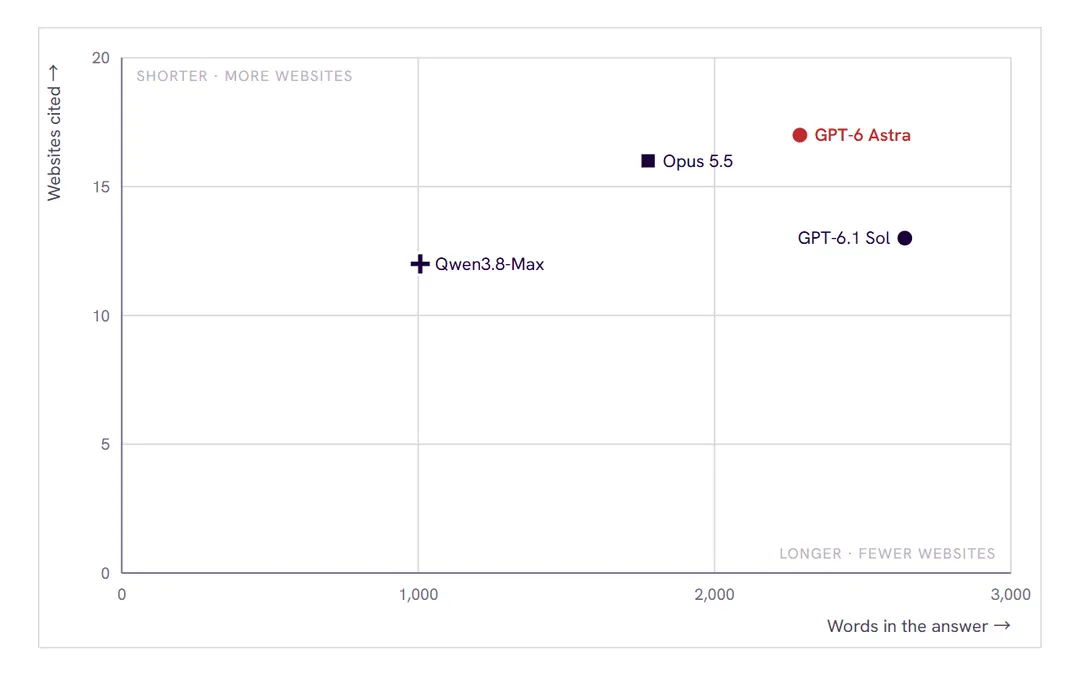
Which AI model searches the web better on a Japan food-buyer needs question with wacky ideas welcome?
We asked four AI models the same question, with web search on, and kept one answer from each. The question is the buyer needs question with one change, in its last line. This page counts the websites each answer cites. It does not open the links, so it cannot say whether the pages back what the answers wrote. It compares the models, not their advice.
As asked, word for word.
Search extensively about what the Japanese food buyers need. Not want or simply looking for with curiosity.
We are stuck in Japan, so let's do a refresh. what can we hill climb on, where's the best chances,
The goal is to identify what they need, and customize our food product line solely to Japan.
I want ideas based on facts, yet totally open to WACKY ideas and suggestions
Output condition
- Include fact links after the paragraph or sentence
The last line adds permission: ideas must still rest on facts, and wacky ideas are welcome too. The rest matches the question without that line, including the link after each paragraph or sentence. It tests whether a model keeps searching for sources once it may speculate.
Which model researched further?
Show as a table
| Answer | Words | Websites cited |
|---|
More websites means the model looked further. It does not mean the answer is right. That needs the link check below, which has not run for this question.
Do the cited pages back what the models wrote? Not checked yet.
In a checked comparison, we open every cited link and compare the page with the passage that cites it. For this question that has not happened. The numbers below say how much there is to check.
Cited links · one square per link, none opened yet
Until then, treat every figure in these answers as a lead, not a fact. Open the page before a number goes into your plan. To see what a finished check looks like, read the comparison How effective are interpreters and translation tools at trade-show booths in Japan?.
What this means when you pick a model for research.
Every answer is longer than its counterpart on the question without the wacky line.
Opus 5.5 wrote 1,776 words instead of 1,565, GPT-6.1 Sol 2,642 instead of 2,074, GPT-6 Astra 2,288 instead of 2,195, and Qwen3.8-Max 1,007 instead of 796. Websites rose for three of the four. Opus 5.5 fell from 22 to 16. Each model ran once on each question, so this shows what happened in these runs, not a trend.
Three answers set the unusual ideas apart.
Opus 5.5 has a section called 'Wacky ideas, all anchored in the facts above', with eight ideas. GPT-6.1 Sol adds 'Four unconventional concepts' and says they are proposed products, not claims of established demand. Qwen3.8-Max gives each of its six needs a 'Wacky Hill Climb'. GPT-6 Astra does not label any idea as unusual.
Qwen3.8-Max again cites no Japanese government site.
Its twelve sites include facebook.com and linkedin.com. GPT-6 Astra and GPT-6.1 Sol cite maff.go.jp, the site of the agriculture ministry.
Every answer, with its numbers.
| Model | Setting | Asked | Words | Websites | Links |
|---|---|---|---|---|---|
| Opus 5.5 | Extra | 6 Oct 2026 | 1,776 | 16 | 26 |
| GPT-6.1 Sol | Max | 6 Oct 2026 | 2,642 | 13 | 24 |
| GPT-6 Astra | Max | 6 Oct 2026 | 2,288 | 17 | 19 |
| Qwen3.8-Max | Thinking | 6 Oct 2026 | 1,007 | 12 | 12 |