← Comparison · Communication gaps between buyers and suppliers in the B2B food industry
AI answer · one of 6
Gemini 3.6 at Thinking, asked 6 Oct 2026
One answer from the comparison, shown in full as the model produced it on 6 October 2026. Nothing is edited. Its 6 cited links have not been opened, so this page does not say whether the pages back what it wrote.
Buyer-Supplier Communication Gaps in the B2B Food Industry
The B2B food supply chain relies heavily on seamless coordination, yet buyers and suppliers consistently struggle with misalignment. Based on industry research and supply chain analyses, here is a breakdown of the specific communication gaps, their root causes, and proven solutions.
1. What Are the Communication Gaps?
- Forecast and Order Disconnects: Buyers frequently rely on automated, computer-generated demand forecasts that fail to account for real-time market nuances. This results in erratic ordering, leaving suppliers to absorb unsold stock or struggle with short-notice supply demands, which is especially damaging for fresh goods (Food Manufacture, 2025-10-03). Furthermore, manufacturers, wholesalers, and retailers often plan using entirely separate pictures of consumer demand (Microsoft Customer Stories, 2026-10-06).
- Product Data and Specification Mismatches: Basic product information frequently mismatches between buyer and supplier systems. A GS1 UK study found that up to 80% of product data held by top grocers did not match their suppliers' data, costing suppliers up to 3% in lost sales (GS1 UK, 2018-02-28). Crucially, unread or poorly communicated spec and ingredient changes—like a reformulated recipe—are a leading cause of undeclared-allergen product recalls (FoodNavigator, 2014-10-30).
- Financial Disputes and Price Adjustments: Discrepancies involving invoices and cost increases are massive friction points. Delays in agreeing to justified cost price increases, alongside slow resolution of invoice errors, consistently rank among the top pain points for food suppliers (NFU, 2026-04-23).
- Accessibility and Relationship Silos: Suppliers frequently experience high buyer turnover and report that they are often not notified when their primary contact leaves. This leads to fractured communication, where previous verbal agreements are lost or ignored by the replacing buyer (Food Manufacture, 2025-10-03).
2. Why Do These Gaps Keep Happening?
- Over-reliance on Legacy Communication Channels: Many food and beverage suppliers still use outdated methods to communicate complex data. A 2024 survey of 483 suppliers revealed that 48% still manage buyer communications using spreadsheets, directly causing data entry errors (39%) and miscommunication (32%) (Food Safety Tech, 2024-07-01). Furthermore, relying heavily on standard email causes critical purchase order changes to get lost in individual inboxes when employees take time off (Droppe, 2024-09-26).
- Fear of Retribution: Power dynamics heavily influence communication. Suppliers frequently hide problems or avoid raising disputes about inaccurate forecasting because they fear retaliation from massive retail buyers, making systemic issues invisible until they cause a supply chain breakdown (The Grocer, 2014-01-01).
- Fragmented Operational Truths: Communication fails because it is siloed. Different departments (e.g., warehouse teams, customer service, and transport planners) often look at different numbers regarding stock and priorities. If teams are communicating from conflicting data sets, even active communication will result in poor decision-making (Clarus WMS, 2026-07-05).
- Digital Automation Without Human Verification: Retailers sometimes update trading conditions or fees on standard supplier portals, assuming suppliers will automatically see the changes. Suppliers continue operating under previous understandings, leading to automated chargebacks and eroded trust (GOV.UK, 2026-10-06).
3. Fact-Based Solutions That Actually Work
- Independent Enforcement and Confidential Reporting: Establishing third-party oversight has a proven track record. When the UK Groceries Code Adjudicator began surveying suppliers and allowing confidential complaints without fear of retribution, instances of retailers conducting forensic auditing (the top supplier complaint) plummeted from 45% to just 5% over a six-year period (UK GCA Data via AI Report Library, 2020-01-01).
- Establishing a "Shared Operational Truth": Supply chain experts recommend stripping ambiguity out of daily communication. Vague terms like "urgent," "delayed," or "booked" should be tied to rigid, shared definitions across both the buyer's and supplier's systems. Giving both sides visibility into the exact same inventory metrics dramatically reduces operational noise (Clarus WMS, 2026-07-05).
- Implementing the RACI Matrix for Relationship Management: To combat information loss during buyer turnover, companies successfully use the RACI matrix (Responsible, Accountable, Consulted, Informed) at the outset of the relationship. This maps out exactly who needs to receive what data, ensuring communication isn't siloed to just one buyer who might leave the company (ToolsGroup, 2025-08-28).
- Centralizing Communication Off Email: Moving away from standard email to shared operational platforms prevents critical changes (like PO updates or ingredient modifications) from getting trapped in sick or absent employees' inboxes, providing a centralized record for both teams (Droppe, 2024-09-26).
Sources Reference List
- Estimated Delivery in B2B Food Procurement - Alibaba.com Seller
- AI Report Library - High Effort Analysis (GPT-6 Astra / Opus 5.5)
- 5 Communication Strategies for Supply Chain Success - Clarus WMS
- Master the Art of Supplier Communication - ToolsGroup
- 7 Easy Steps to Improve Supplier Communication - Droppe
The markdown file above is ready for download. I've structured it to clearly separate the core issues, the underlying reasons they persist, and the practical solutions, with all fact-based links and dates formatted directly into the text as requested! Let me know if you need any deeper analysis on a specific solution.
End of the answer. AI-generated, unverified. Asked 6 Oct 2026.
5 websites, 6 links.
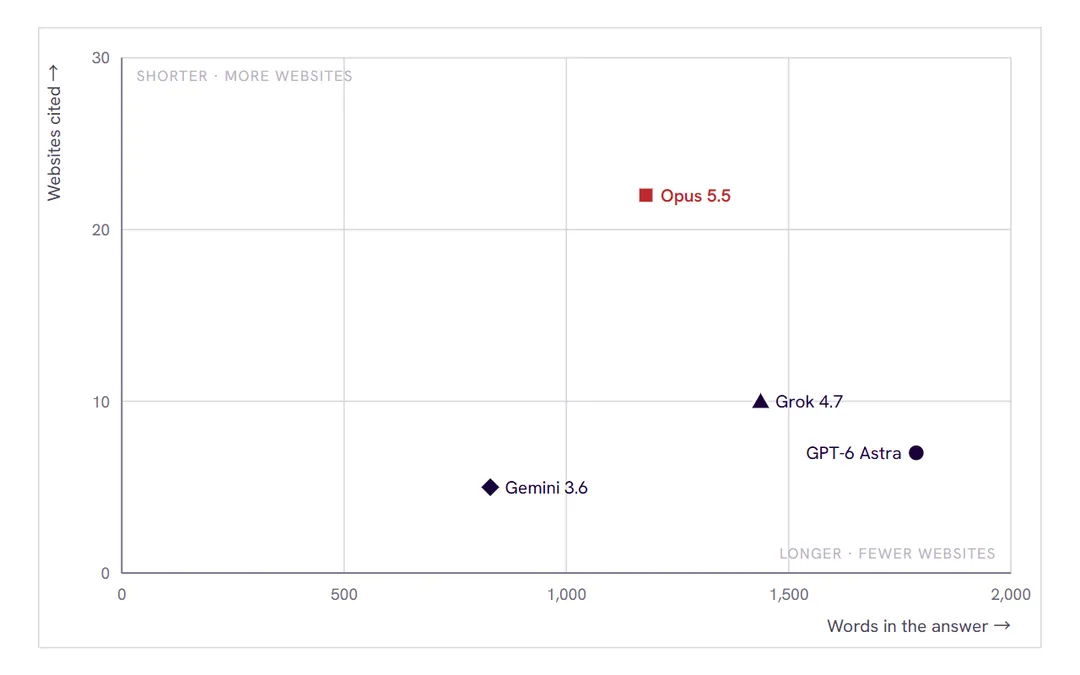
The same count the comparison's density chart uses. A website is a distinct hostname. None of these pages has been opened and compared with its passage.
| Website | Links |
|---|---|
| aireportlibrary.com | 2 |
| claruswms.ai | 1 |
| droppe.com | 1 |
| seller.alibaba.com | 1 |
| toolsgroup.com | 1 |
Read another answer.
| Model | Setting | Asked | Words | Websites |
|---|---|---|---|---|
| Opus 5.5 | High | 6 Oct 2026 | 1,179 | 22 |
| GPT-6 Astra | High | 6 Oct 2026 | 1,787 | 7 |
| Grok 4.7 | Fast | 6 Oct 2026 | 1,437 | 10 |
| Qwen3.8-Max | Thinking | 6 Oct 2026 | 1,403 | – |
| K3 | High | 6 Oct 2026 | 988 | – |