
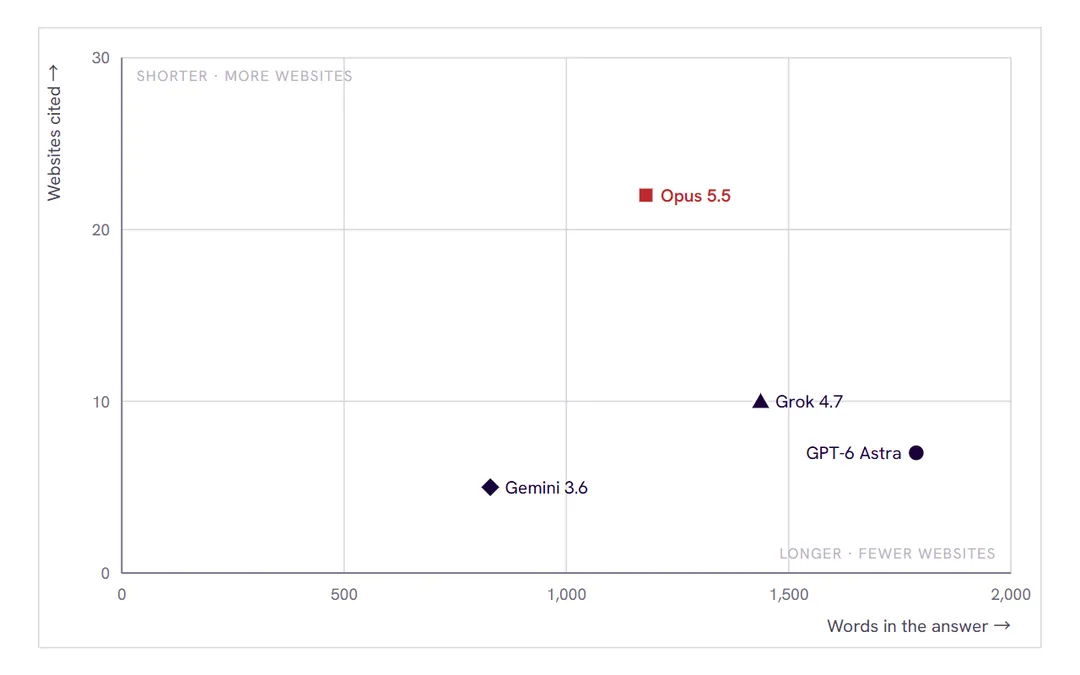
Grok 4.7 at Fast, asked 6 Oct 2026
One answer from the comparison, shown in full as the model produced it on 6 October 2026. Nothing is edited. Its 14 cited links have not been opened, so this page does not say whether the pages back what it wrote.
Communication Gaps Between Buyers and Suppliers in the B2B Food Industry
1. Key Communication Gaps
In the B2B food industry, communication gaps between buyers (brands, manufacturers, retailers) and suppliers (ingredient providers, co-manufacturers, distributors) are widespread and costly. These gaps manifest as incomplete information exchange, version control failures, and siloed data, often leading to delayed product launches, compliance risks, and margin erosion.
One of the most common issues is the "partial-answer loop." Buyers, particularly R&D and procurement teams, frequently send detailed questionnaires (often 40–50 questions) requesting specs, Certificates of Analysis (COAs), nutritional panels, allergen statements, certifications (Kosher, Halal, GFSI/SQF), insurance, and MSDS sheets. Suppliers typically respond with only a subset of the requested information and attachments, triggering repeated follow-ups that scatter updates across multiple inboxes. (Waystation AI, 2025-12-04; Waystation AI, 2026-03-11)
Fragmented information ownership exacerbates the problem. R&D, Quality Assurance (QA), procurement, and operations maintain separate tools, spreadsheets, shared drives, and naming conventions. The same supplier conversation exists in multiple incomplete copies, with no single source of truth. Co-manufacturer gaps are particularly acute: brands assume co-manufacturers hold the latest specs, but they often possess outdated versions from early development stages, creating risks during production or audits. (Waystation AI, 2025-12-04; SupplySide Food & Beverage Journal, 2026-03-18)
Document expiration and compliance tracking present another persistent gap. Certifications, audits, and insurance documents expire on staggered schedules. When tracking relies on memory, calendars, or manual processes, gaps appear precisely during retailer audits, leading to fines, delistings, or recalls. In agri-food supply chains, information asymmetry further compounds these issues, driven by factors such as increasing regulation, documentation requirements, incorrect internal data, crises, political conflicts, and supplier–buyer power imbalances. (Emerald Publishing / International Journal of Logistics Management, 2024-09-13; Waystation AI, 2026-03-11)
Broader surveys confirm the scale: In the 2024 HICX Voice of the Supplier Survey of 1,000 suppliers serving large multinationals (including CPG/food-related firms), 98% stated that their biggest customers need to communicate better, nearly half struggled to resolve queries, and 59% reported difficulty doing their best work for major customers. (HICX, 2024-06-27)
2. Why These Gaps Persist
These communication gaps endure despite awareness because of entrenched workflows, structural incentives, and resistance to change.
Email remains the default "common language" for supplier communication. Suppliers know it, co-manufacturers know it, and internal teams rely on it. Attempts to replace email with portals or new logins often fail because suppliers refuse to alter their established workflows. Information continues to flow through email, while central systems starve for structured data. (Waystation AI, 2025-12-04)
Internal organizational silos reinforce the problem. Different departments use incompatible tools and processes, and there is rarely automated sharing between them. Innovation-driven supplier churn adds continuous onboarding load: new projects introduce new vendors, new documents, and fresh version confusion, preventing the communication burden from stabilizing. Co-manufacturers introduce a parallel information universe that brands are poorly equipped to keep synchronized. (Waystation AI, 2025-12-04; Waystation AI, 2026-03-11)
Power dynamics and information asymmetry play a structural role. In food supply chains, power often increases closer to end markets, leading buyers to restrict information sharing even when suppliers desire collaboration. Studies in the Finnish food industry and broader European agri-food chains show that power imbalances limit information exchange and collaborative willingness. Additional drivers of asymmetry include price performance pressures, limited digitalization, environmental/process/quality measurement gaps, rising documentation and regulatory burdens, consumer behavior shifts, and external crises. (British Food Journal / EurekaMag, 2010; Emerald Publishing, 2024-09-13; University of Bonn / IFAMA, survey of 1,026 actors)
Traditional "fixes" such as new portals, ERP modules, or shared-drive reorganizations fail because they assume information will flow into a central system. In practice, the high volume and document density of modern CPG/food sourcing overwhelm manual processes, and teams remain stuck in reactive mode. (Waystation AI, 2026-03-11)
3. Solutions That Have Demonstrably Worked
Evidence-based solutions focus on structuring existing communication channels rather than forcing wholesale behavioral change, combined with relationship and technology enablers.
Structuring email and automating extraction (without requiring supplier portals): Platforms that automatically capture incoming supplier emails, extract specs, quotes, certifications, and lead times into a shared searchable record, track expirations, and provide real-time visibility across procurement, QA, and R&D have produced measurable results. Gold Coast Bakery achieved more than $200K in annualized savings within 90 days (30-day payback, 11.7% average ingredient savings, 50% faster RFP cycles). JUNKLESS Foods realized $412K in savings across 11 ingredients and established secondary sourcing for over 25% of their ingredient base. Standardized request templates further reduced follow-up volume. (Waystation AI, 2026-03-11)
Centralized single source of truth and real-time data sharing: Shared platforms that eliminate email-chasing for order confirmations, forecasts, and documents improve On-Time In-Full (OTIF) performance (up to 95% in some reported cases) and reduce the 30–50% of planner time spent on manual supplier chasing. Automatic vendor data pulls, version history, and role-based access enable faster commercialization while lowering risk. (Coupa, 2026-10-06; Galley Solutions, 2022-09-15)
Buyer-driven knowledge transfer and relationship mechanisms: Structured knowledge-transfer activities by buyers improve supplier transparency both directly and indirectly (via perceived relationship transparency and expected resource access). Effective communication frequency and high information quality are the strongest predictors of good buyer–supplier relationships in European agri-food chains (survey of 1,026 farmers, processors, and retailers). Personal bonds and more balanced power distribution further strengthen outcomes. (Emerald Publishing / International Journal of Physical Distribution & Logistics Management, 2025-04-10; University of Bonn / IFAMA)
Collaborative models tailored to context: In Dutch food processing supply chains, three proven collaboration paths deliver results: (1) bilateral (equal participation) yielding substantial environmental and economic benefits; (2) buyer-driven for stakeholder-driven sustainability and traceability (higher cost but reputation gains); (3) supplier-driven for incremental improvements. Joint Business Planning (JBP), standardized templates, regular cadence meetings, and clear escalation procedures also reduce friction. (Emerald Publishing / Supply Chain Management, 2024-08-02; Aurora Training Advantage / best practices)
Digital tools adapted to existing behaviors: Solutions that integrate with email/WhatsApp or provide mobile-first visibility (e.g., real-time ETAs, ePOD) improve coordination without requiring full platform adoption by every supplier. In food export and distribution contexts, centralized team inboxes and automated notifications have reduced miscommunication significantly. (FourKites, 2025-10-27; various platform case insights)
Summary of Evidence-Based Recommendations
- Stop fighting email—structure and automate it so data is extracted once and shared.
- Create a true single source of truth accessible to R&D, QA, procurement, and co-manufacturers.
- Invest in relationship quality (frequency + information quality + personal bonds) alongside technology.
- Match collaboration intensity to the specific goal (bilateral for core process innovation; lighter models for incremental gains).
- Measure the "communication tax" directly (hours spent on triage vs. strategic work; ability to surface all quotes/certs in one view; certification expiry visibility).
These approaches have moved teams from reactive information gathering to strategic action, delivering documented margin improvements, faster cycles, and reduced compliance risk.
Sources and URLs
-
Waystation AI – "The Hidden “Communication Tax” Crippling Food and Beverage Teams"
https://waystationai.com/the-hidden-communication-tax-crippling-food-and-beverage-teams/
(Published approx. 2025-12-04) -
Waystation AI – "The hidden communication tax crippling food and beverage teams"
https://www.waystationai.com/blog/the-hidden-communication-tax-crippling-food-and-beverage-teams/
(Published 2026-03-11) -
SupplySide Food & Beverage Journal – "Improving food, beverage operations with shared ingredient data"
https://www.supplysidefbj.com/food-beverage-operations/streamlining-collaboration-between-r-d-procurement-for-faster-ingredient-sourcing
(Published 2026-03-18) -
HICX – "98% Of Suppliers Want Better Communication" (Voice of the Supplier Survey 2024)
https://www.hicx.com/news/98-of-suppliers-want-better-communication/
(Published 2024-06-27) -
HICX – Voice of the Supplier Survey 2024 resources
https://www.hicx.com/whitepapers/voice-of-the-supplier-survey-2024/
(2024) -
Emerald Publishing – "Determinants of information asymmetry in agri-food supply chains" (International Journal of Logistics Management)
https://www.emerald.com/ijlm/article/36/1/259/1242345/Determinants-of-information-asymmetry-in-agri-food
(Accepted 2024-09-13) -
EurekaMag / British Food Journal – "The impact of power on information sharing in the Finnish food industry"
https://eurekamag.com/research/070/637/070637081.php
(2010) -
University of Bonn / IFAMA – "Business Relationships and B2B Communication in Selected European Agri-food Chains"
https://ageconsearch.umn.edu/record/53645/files/20071038_Formatted.pdf
(Survey of 1,026 actors) -
Emerald Publishing – "How buyer-driven knowledge transfer activities affect supplier transparency in the food supply chain"
https://www.emerald.com/ijpdlm/article/55/7/791/1268226/How-buyer-driven-knowledge-transfer-activities
(Accepted 2025-04-10) -
Emerald Publishing – "Different paths to improving together: a taxonomy of buyer-supplier collaborations for sustainability in food supply networks"
https://www.emerald.com/scm/article/29/6/996/1224628/Different-paths-to-improving-together-a-taxonomy
(Accepted 2024-08-02) -
Coupa – "Supply Chain Collaboration ERP-Agnostic Standalone Solution"
https://www.coupa.com/blog/standalone-supply-chain-collaboration/
(Published 2026-10-06) -
Galley Solutions – "How Collaboration and Communication Is The Future of Food"
https://www.galleysolutions.com/blog/how-collaboration-and-communication-is-the-future-of-food
(Published 2022-09-15) -
FourKites – "The Power of Better Communication and Collaboration Across the Supply Chain"
https://www.fourkites.com/blogs/the-power-of-better-communication-and-collaboration-across-the-supply-chain/
(Published 2025-10-27) -
FoodChain ID – "Seamless Collaboration: Reducing Friction in Supplier and Manufacturer Interactions"
https://www.foodchainid.com/resources/seamless-supplier-collaboration/
(Published 2024-03-21)
Note: Dates reflect publication or acceptance dates available from sources. Some academic articles may have earlier online availability.
End of the answer. AI-generated, unverified. Asked 6 Oct 2026.
10 websites, 14 links.
The same count the comparison's density chart uses. A website is a distinct hostname. None of these pages has been opened and compared with its passage.
| Website | Links |
|---|---|
| emerald.com | 3 |
| hicx.com | 2 |
| waystationai.com | 2 |
| ageconsearch.umn.edu | 1 |
| coupa.com | 1 |
| eurekamag.com | 1 |
| foodchainid.com | 1 |
| fourkites.com | 1 |
| galleysolutions.com | 1 |
| supplysidefbj.com | 1 |
Read another answer.
| Model | Setting | Asked | Words | Websites |
|---|---|---|---|---|
| Opus 5.5 | High | 6 Oct 2026 | 1,179 | 22 |
| GPT-6 Astra | High | 6 Oct 2026 | 1,787 | 7 |
| Gemini 3.6 | Thinking | 6 Oct 2026 | 829 | 5 |
| Qwen3.8-Max | Thinking | 6 Oct 2026 | 1,403 | – |
| K3 | High | 6 Oct 2026 | 988 | – |