Opus 5.5 at Medium, asked 8 Oct 2026
One answer from the comparison, shown in full as the model produced it on 8 October 2026. Nothing is edited. Its 13 cited links have not been opened, so this page does not say whether the pages back what it wrote.
I'll check your food-product context, then research the main Japanese crowdfunding platforms' fees, ad options, and agency costs to build a 6 to 12 month total cost comparison.
I've ranked the top 5 below by how well each fits an overseas food brand. The main finding is that the platform commission is only about a fifth to a quarter of what a 6 to 12 month crowdfunding program costs in Japan. Ads, fulfillment, the import setup and average order value change your total cost more than the gap between platforms does.
Top 5 channels for an overseas food brand
1. Makuake: the default for a "new product debut" Makuake is the biggest market by money raised. For January to May 2026, Makuake raised about ¥7.87B, a 44.2% share of the market, while CAMPFIRE led on project count with 65.5%. (craco via PR TIMES, 2026-06-15)
Its official fee is 20% (tax excluded) of the backed amount for Makuake projects, and an optional paid ad support package exists for projects that meet internal criteria. (Makuake legal notice, accessed 2026-10-08)
For overseas makers, Makuake runs a Global Official Partner Program. Makuake introduces a partner that acts as the project's operating agent, handling page creation, pre-launch promotion and backer support through delivery. (ECのミカタ, date not shown, accessed 2026-10-08)
One caveat: Makuake requires projects to state when a product is an import-agency or overseas OEM item. Your story needs to be about what is new for Japan, not just "imported." (Impress Watch, accessed 2026-10-08)
2. CAMPFIRE: cheaper, high volume, less hand-holding CAMPFIRE's standard fee has been 17% (tax excluded). (ASCII, accessed 2026-10-08) Of that, the payment portion is 5% of the backed amount, and a separate per-backer system fee is charged. (ネットショップ担当者フォーラム, 2026-07-30)
CAMPFIRE has a large audience, about 394,000 backers in Jan to May 2026, a 40.7% share. The weakness is that its project count is huge, so it is easy to get buried without your own traffic. (craco via PR TIMES, 2026-06-15)
3. Kibidango ("Kibitan" program): the only model that takes over import and logistics This is structurally different from the others. Kibidango becomes the seller and manages import and logistics, and also handles backer support. The tradeoff is that its track record is almost entirely gadgets and goods. A food brand would be an exception for them, so confirm fit before planning around it. (Kibidango Kibitan page, stats as of 2026-10-08)
Kibidango has historically advertised a 10% fee, but that figure comes from a 2016 release. Under the Kibitan model, your real cost is the margin you give up in a negotiated split, and that split is not public. (value-press, 2016)
4. GREEN FUNDING: only for premium, high-ticket food-adjacent items It had only 107 projects in Jan to May 2026, but averaged about ¥13.69M each, more than 7 times the market average of about ¥1.82M. That average reflects a gadget-heavy audience. It fits only if your item is premium kitchen or beverage gear rather than consumable food. (craco via PR TIMES, 2026-06-15)
A comparison site lists its Standard plan fee at 18.2%. I could not confirm this on an official page, so treat it as indicative. (gooddo, date not shown, accessed 2026-10-08)
5. READYFOR: only if there is a social or regional story READYFOR is strong in social causes. "READYFOR × Social" raised about ¥1.71B in Jan to May 2026, the fourth-largest platform-category combination. (craco via PR TIMES, 2026-06-15)
It is a weak fit for a commercial food launch unless there is a producer-community or sustainability angle. I did not verify its current fee.
Kickstarter is not in the top 5. Its fees are low, 5% plus roughly 3 to 5% payment processing, but its backers are not Japanese consumers. (Kickstarter Help Center, accessed 2026-10-08)
The cost that applies to every platform: import compliance
Food is harder than gadgets in one way that holds on any platform. Food imported for sale requires an import notification by the importer under Article 27 of the Food Sanitation Act, and food without that notification cannot be sold. (MHLW, accessed 2026-10-08)
The importer also carries the same legal responsibility as a domestic manufacturer or seller. (JETRO, accessed 2026-10-08)
So you need a Japanese importer of record before any campaign. Kibidango is the only channel above that takes on that role itself.
Total cost model for 12 months
The agency rates come from a 2026 listing for a crowdfunding consultancy: production and planning support of ¥300k to ¥1M, a success fee of 10% of the amount raised, an average of ¥1M to ¥1.5M per project, and about 6 months per project. (Batonz listing, updated 2026-05-29)
Everything else in the table is my estimate, not sourced data. The scenario is two campaign waves of ¥3M each, so ¥6M total, with an average order of ¥5,000, which works out to about 1,200 orders.
| Cost line | Makuake | CAMPFIRE | Basis |
|---|---|---|---|
| Platform commission (incl. 10% tax) | ¥1.32M (22%) | ¥1.12M (18.7%) | Official rates above |
| Agency or partner (production plus 10% success fee) | ~¥1.25M | ~¥1.25M | Batonz 2026 listing |
| Ads (assumed 10 to 25% of GMV) | ¥0.6M to ¥1.5M | ¥0.6M to ¥1.5M | My assumption |
| Fulfillment (assumed ~¥1,200 per order, shelf-stable) | ~¥1.44M | ~¥1.44M | My assumption; chilled costs more |
| Importer and label setup | ~¥0.5M | ~¥0.5M | My assumption |
| Total before product cost (COGS) | ~¥5.1M to ¥6.0M | ~¥4.9M to ¥5.8M |
Four things stand out from this:
- Choosing a platform saves about ¥200k over 12 months. That is around 3 percentage points of GMV. Fulfillment and ads each cost more than that difference.
- Average order value is the biggest lever. At ¥5,000 per order, fulfillment alone eats about 24% of GMV. A ¥10,000 bundle cuts that roughly in half.
- At ¥6M GMV, channel costs consume most of the revenue before product cost. At this scale, crowdfunding works as paid market validation, not as profit. Budget it that way.
- Kibidango shifts most of the import, fulfillment and support cost onto them, in exchange for a margin share. For a limited budget, that makes it worth an inquiry even though its catalog skews to gadgets.
Using a campaign as evidence for Japanese buyers
Since the goal is to adapt the product line for Japanese buyers, a better use of the money than "testing" is to run one Japan-specific SKU on Makuake, ideally a bundle with a high average order. The campaign then gives you backer counts, sell-through by variant and review language. That data becomes your pitch to retail buyers in months 6 to 12, which is the part a pure test never produces.
Sources:
- craco via PR TIMES: Jan to May 2026 market report (2026-06-15)
- Makuake legal notice (accessed 2026-10-08)
- ECのミカタ: Makuake Global Official Partner Program (accessed 2026-10-08)
- Impress Watch: Makuake policy on imported products (accessed 2026-10-08)
- ASCII: CAMPFIRE fee plans (accessed 2026-10-08)
- ネットショップ担当者フォーラム: CAMPFIRE payment fee (2026-07-30)
- Kibidango Kibitan program (as of 2026-10-08)
- value-press: Kibidango 10% fee (2016)
- gooddo: fee comparison table (accessed 2026-10-08)
- Kickstarter Help Center: fees (accessed 2026-10-08)
- MHLW: food import procedures (accessed 2026-10-08)
- JETRO: Food Sanitation Act inspections (accessed 2026-10-08)
- Batonz: crowdfunding consultancy pricing (updated 2026-05-29)
End of the answer. AI-generated, unverified. Asked 8 Oct 2026.
13 websites, 13 links.
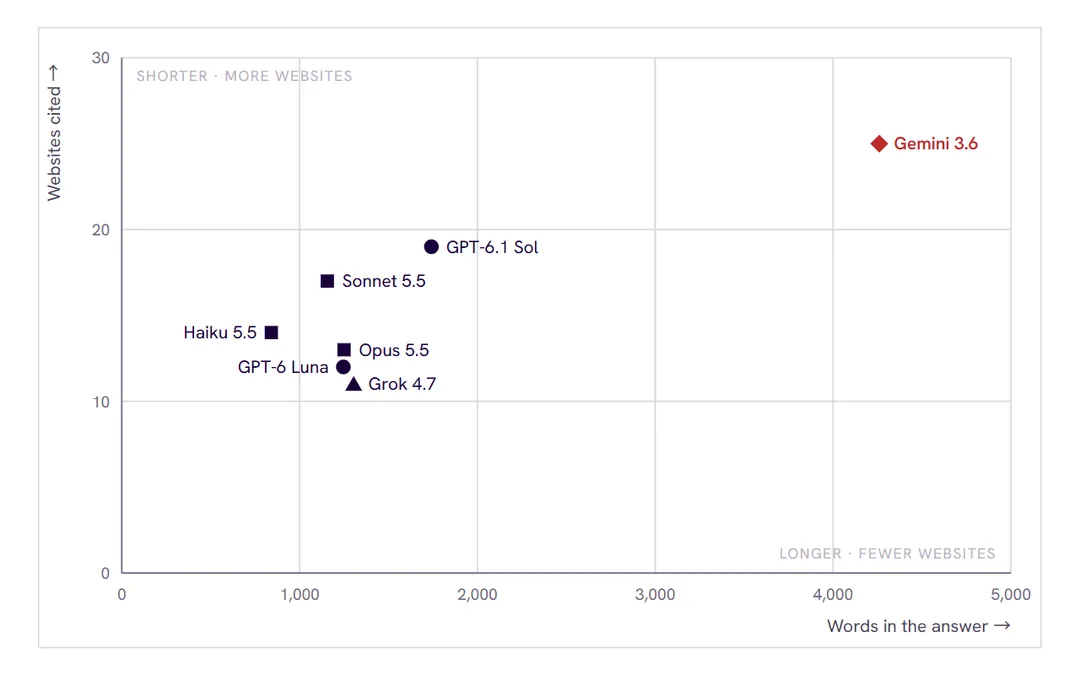
The same count the comparison's density chart uses. A website is a distinct hostname. None of these pages has been opened and compared with its passage.
| Website | Links |
|---|---|
| ascii.jp | 1 |
| batonz.jp | 1 |
| ecnomikata.com | 1 |
| gooddo.jp | 1 |
| help.kickstarter.com | 1 |
| jetro.go.jp | 1 |
| kibidango.com | 1 |
| makuake.com | 1 |
| mhlw.go.jp | 1 |
| netshop.impress.co.jp | 1 |
| prtimes.jp | 1 |
| value-press.com | 1 |
| watch.impress.co.jp | 1 |
Read another answer.
| Model | Setting | Asked | Words | Websites |
|---|---|---|---|---|
| Sonnet 5.5 | Medium | 8 Oct 2026 | 1,156 | 17 |
| GPT-6 Luna | Max | 8 Oct 2026 | 1,246 | 12 |
| GPT-6.1 Sol | Max | 8 Oct 2026 | 1,741 | 19 |
| Gemini 3.6 | Thinking | 8 Oct 2026 | 4,260 | 25 |
| Grok 4.7 | Fast | 8 Oct 2026 | 1,304 | 11 |
| Qwen3.8-Max | Thinking | 8 Oct 2026 | 1,134 | – |
| Qwen3.8-Omni-Flash | Thinking | 8 Oct 2026 | 1,661 | – |
| Haiku 5.5 | Extra | 8 Oct 2026 | 841 | 14 |