
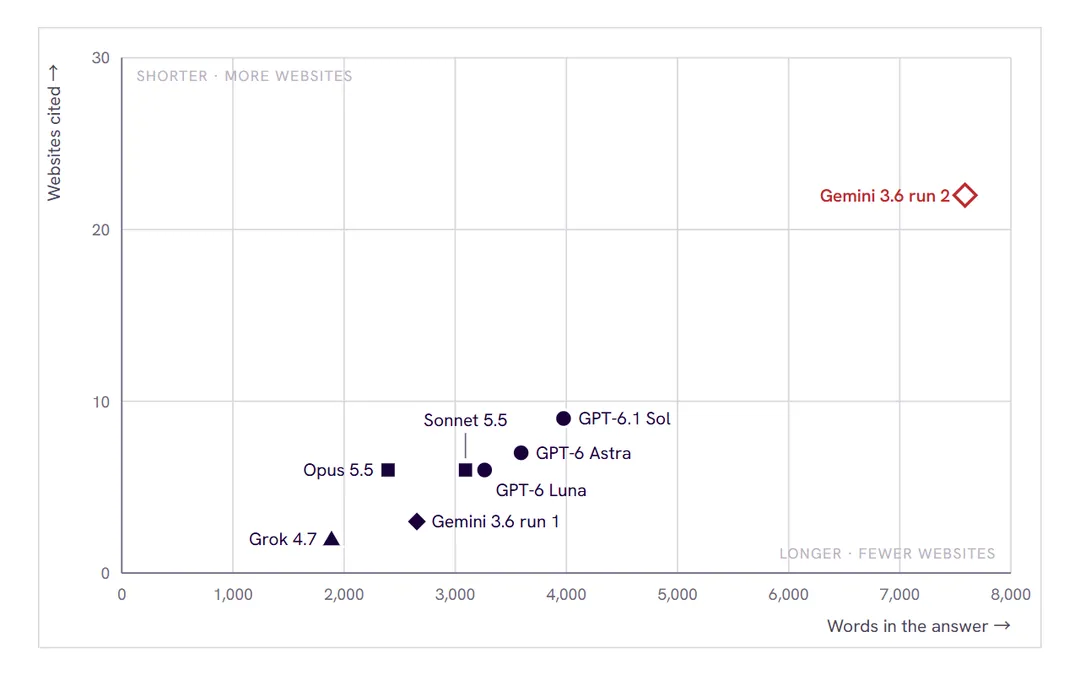
Which AI model searches the web better on a Kato Sangyo sourcing question?
We gave seven AI models the same research brief on the Japanese food wholesaler Kato Sangyo, with web search on, and Gemini 3.6 answered twice. This page counts the websites each answer cites and sets that against the answer's length. We have not yet opened the cited links to see whether they back the answers. It compares the models, not their advice.
As asked, word for word.
ROLE
You are a senior B2B research analyst specializing in the Japanese food and beverage distribution industry. You research in both Japanese and English and you never fabricate sources.
CONTEXT
Target company: 加藤産業株式会社 (Kato Sangyo Co., Ltd.), https://www.katosangyo.co.jp/ It is a Japanese food and beverage wholesaler. Verify basic facts (HQ, listing, size, business segments, group companies, private brands, import business, overseas subsidiaries) yourself before using them.
The research supports a market entry consultancy that helps overseas food and beverage brands enter Japan. We want to understand Kato Sangyo's pains, struggles and concerns in SOURCING new, interesting or differentiated products (domestic or imported), so we can judge whether and how we could help.
RESEARCH QUESTION
What pains, struggles and concerns does Kato Sangyo face in finding, evaluating, onboarding and scaling interesting and high-quality products, and what evidence supports each one?
SCOPE: investigate at minimum
1. Sourcing strategy: what the company says it wants (new categories, imports, private brand, regional products, health, premium, convenience).
2. Discovery: how it finds new products and suppliers (trade shows such as FOODEX JAPAN, its own exhibitions, overseas offices, partners).
3. Import and overseas sourcing: FX/yen weakness, logistics cost, Japanese labeling and regulatory compliance, minimum order quantities, shelf life, quality assurance.
4. Retailer side pressure: retailer consolidation, retailer private brands, shelf space competition, demands for differentiation, price pass through.
5. Margins and cost: wholesaler margin squeeze, rebates, logistics 2024 problem (物流2024年問題), labor shortages, cost inflation.
6. Supplier side issues: manufacturer consolidation, direct to retail sales bypassing wholesalers, small suppliers lacking Japan readiness.
7. Internal capability: merchandising (MD) talent, data, speed of new product introduction, risk tolerance.
8. Competitive context: how peers (e.g. Mitsubishi Shokuhin, Nippon Access, Kokubu Group, Itochu Shokuhin) address the same issues, only where it clarifies Kato Sangyo's position.
SOURCES: priority order
1. Primary: 有価証券報告書, 決算説明資料, 中期経営計画, 統合報告書, IR Q&A, press releases, the corporate website.
2. Executive statements: interviews and speeches by top management in trade media (日本食糧新聞, 食品新聞, 日経MJ, 日本経済新聞, etc.).
3. Secondary: analyst notes, industry reports, government or industry association data.
4. Weak signals: job postings (e.g. buyer or MD roles), exhibitor pages, event reports. Search in Japanese first, then English. Prefer material from the last 3 years and label anything older.
RULES
- Every factual claim must have a source link at the end of that sentence or paragraph, with the publication date in the format (YYYY-MM-DD or YYYY-MM).
- Tag each finding: [FACT] directly stated in a source; [INFERENCE] your reasoning from sources; [HYPOTHESIS] plausible but unsupported, to validate in interviews.
- Give a confidence level (High / Medium / Low) for each pain point.
- Quote the original Japanese for key statements and add an English translation.
- If you cannot find evidence, write "No evidence found" and do not fill the gap with assumptions.
- Do not invent URLs, document titles, figures or quotes. If you are unsure a source exists, leave it out.
- Do not use em dashes in your output.
OUTPUT FORMAT (follow exactly)
1. Company snapshot
5 to 8 bullets with verified basics, each with a source and date.
2. Pain point table
| # | Pain point | Category (from Scope 1 to 8) | Evidence summary | Tag | Confidence | Source (link + date) |
Aim for 8 to 15 rows, ranked by severity for the sourcing function.
3. Top 5 pains in depth
For each: what the pain is, why it exists, how it shows up in day to day sourcing, what the company is already doing about it, and what remains unsolved.
4. Implications for an overseas brand or entry partner
What an overseas supplier must have or prove to get past these pains (e.g. Japanese labeling ready, inventory held in Japan, marketing support, pricing structure).
5. Open questions for interviews
8 to 10 questions to validate the [HYPOTHESIS] items with a Kato Sangyo buyer or MD manager.
6. Source list
All sources with title, publisher, date and URL. Mark primary sources with ★.
7. Research self report
- Searches you ran (queries, JA and EN)
- Sources you tried but could not access
- Your biggest uncertainty in this report
- Date of research
The brief names the company and its website and ranks the sources it wants: annual securities reports and investor materials first, then executive interviews in trade media, then analyst and industry reports, then job postings. It asks for a source link and a date with every factual claim, and for the original Japanese on key statements. It tests whether a model finds Japanese primary documents and trade press.
Which model researched further?
Show as a table
| Answer | Words | Websites cited |
|---|
More websites means the model looked further. It does not mean the answer is right. That needs the link check below, which has not run for this question.
Do the cited pages back what the models wrote? Not checked yet.
In a checked comparison, we open every cited link and compare the page with the passage that cites it. For this question that has not happened. The numbers below say how much there is to check.
Cited links · one square per link, none opened yet
Until then, treat every figure in these answers as a lead, not a fact. Open the page before a number goes into your plan. To see what a finished check looks like, read the comparison How effective are interpreters and translation tools at trade-show booths in Japan?.
What this means when you pick a model for research.
Every answer cites the company's own website.
The brief lists the corporate website among its primary sources. katosangyo.co.jp is one of the websites each of the eight answers cites.
Most of Gemini 3.6 run 1's links go to Google.
Its link text shows the page it means, mostly on katosangyo.co.jp. But 31 of its 34 link targets are Google search addresses that carry that page address in the query. We have not opened the links, so we say nothing about what the intended pages show.
The same model gave two very different answers.
Gemini 3.6 ran twice at one setting. Run 1 is 2,655 words with 3 websites. Run 2 is 7,587 words with 22.
Every answer, with its numbers.
| Model | Setting | Asked | Words | Websites | Links |
|---|---|---|---|---|---|
| Opus 5.5 | High | 4 Oct 2026 | 2,396 | 6 | 17 |
| Sonnet 5.5 | High | 4 Oct 2026 | 3,177 | 6 | 21 |
| GPT-6 Luna | High | 4 Oct 2026 | 3,180 | 6 | 16 |
| GPT-6.1 Sol | High | 4 Oct 2026 | 3,975 | 9 | 29 |
| GPT-6 Astra | High | 4 Oct 2026 | 3,593 | 7 | 21 |
| Gemini 3.6 | Thinking | 4 Oct 2026 | 2,655 | 3 | 18 |
| Gemini 3.6 | Thinking | 4 Oct 2026 | 7,587 | 22 | 30 |
| Grok 4.7 | Fast | 4 Oct 2026 | 1,887 | 2 | 12 |
More model comparisons
- Model comparisonHow effective are interpreters and translation tools at trade-show booths
- Model comparisonMaruto Mizutani: customer segments, strengths, weaknesses, and issues requiring outside help
- Model comparisonBuyer's journey in Japan's food retail and wholesale space
- Model comparisonFood quotations for Japanese retailers and wholesalers: business culture and competitive offers