
Foodservice Automation in Japan: Adoption Conditions for Overseas Robotics Companies
There are visible demand signals for foodservice automation in Japan. But labor shortages and market growth are not really enough to judge whether a product will be adopted.
Key takeaway
There are visible demand signals for foodservice automation in Japan. Labor shortages, service robots, commercial kitchen automation, cleaning automation, and food factory automation all point to a market where operators are looking for ways to reduce operational pressure.
But labor shortages and market growth are not really enough to judge whether a product will be adopted. It depends on more specific conditions: the target segment, the workflow being automated, the buyer, the maintenance model, the ROI logic, and the pilot environment.
So in Japan’s foodservice sector, the practical opportunity is not really full automation. It is more about the fit between a specific task, the physical operating environment, operator economics, and post-installation support.
Who this article is for
This article is for overseas robotics and automation companies that are considering Japan’s foodservice market, especially in areas such as:
- Serving robots
- Commercial kitchen automation
- Cleaning automation
- Food factory and central kitchen automation
- APAC or international business development
It is also relevant for teams comparing Japan across different foodservice environments, including restaurants, chain operators, commercial kitchens, food factories, and central-kitchen-like facilities. The focus is not on robot cafés or consumer-facing novelty use cases, but on practical adoption conditions for B2B automation.
Market signals: labor pressure is visible, but adoption is not automatic
Labor shortage is one reason foodservice automation attracts attention in Japan’s restaurant, accommodation, and related service sectors.
You can see this pressure in employment data. Accommodation and food services have a higher vacancy rate than Japan’s all-industry average, which is part of why labor-saving tools, service robots, and automation are part of the market conversation.
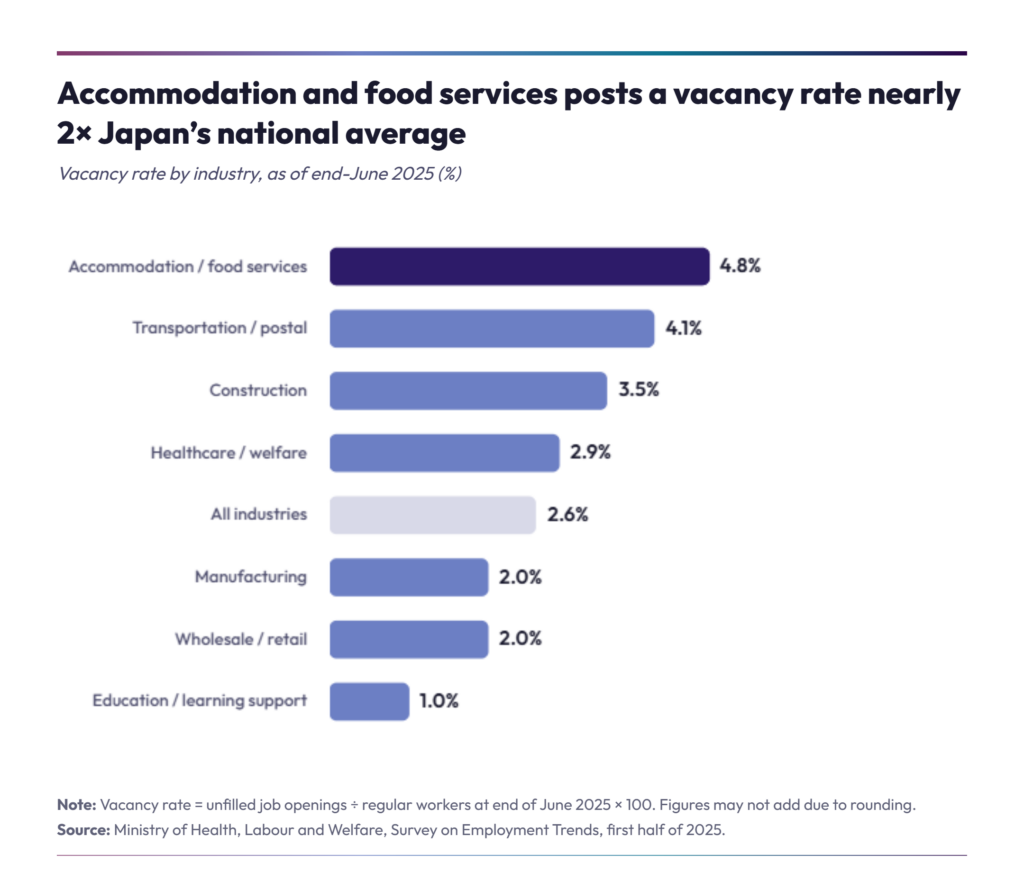
But labor shortage is just a market signal, not proof of adoption. The actual adoption conditions are more specific: where the product fits, which workflow it improves, who owns the budget, and how the equipment is operated and maintained after installation.
Adoption friction: operating fit, cost pressure, and maintenance
Adoption is not really decided by robot capability alone.
In Japan, practical friction generally starts with the operating environment. Store layout, aisle width, kitchen conditions, existing workflows, staff training, maintenance ownership, and system integration can all shape whether a product actually works in daily operations. A robot that performs well in a controlled setting may still struggle if it adds extra steps, increases exception handling, or does not fit the way the site already runs.
And cost is another part of this. Many foodservice operators face high labor and food costs at the same time, and operating margins are already tight. That combination can drive interest in automation, but it also makes adoption more sensitive to payback, maintenance burden, and operational disruption.
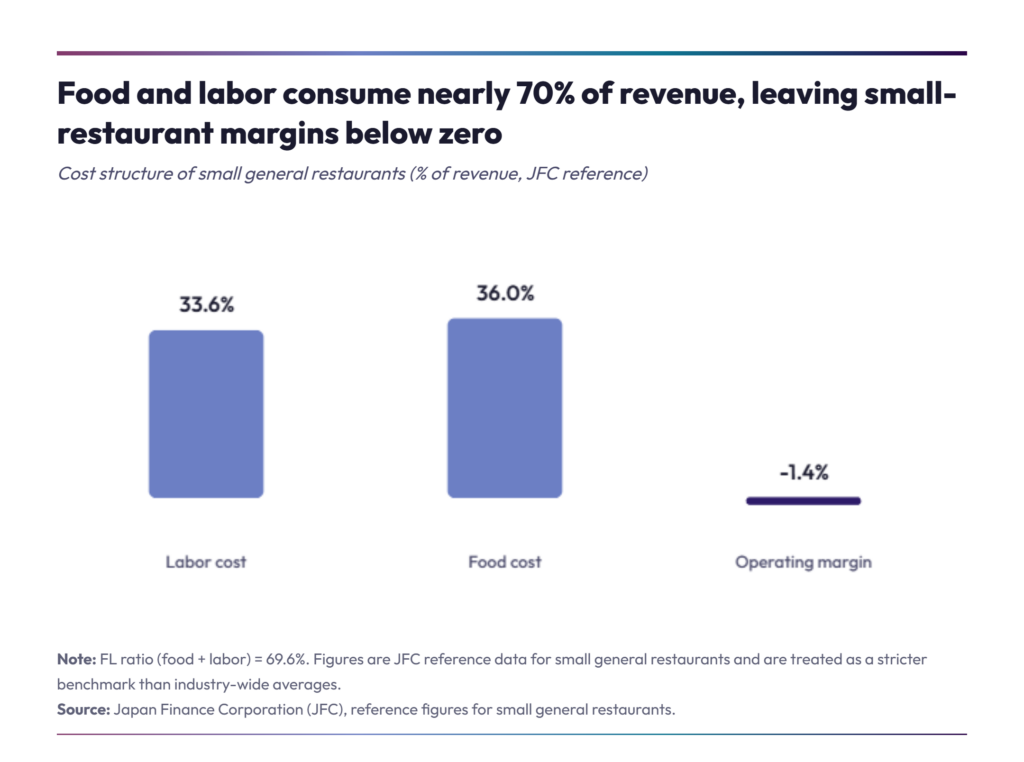
So automation needs a clear business case. In this sector, convenience alone is not enough by itself. The product needs to fit a specific workflow and show value in a form the operator can absorb, whether that comes from labor reduction, more stable operations, better consistency, or lower physical burden on staff.
Segment map: restaurant, kitchen, cleaning, and food factory use cases
Japan’s foodservice automation opportunity is not one market.
Independent restaurants, chain restaurants, institutional kitchens, food factories, and central-kitchen-like facilities differ in scale, operating structure, budget ownership, and adoption conditions. The size of the opportunity may look large overall, but the practical meaning of automation changes a lot across these environments.
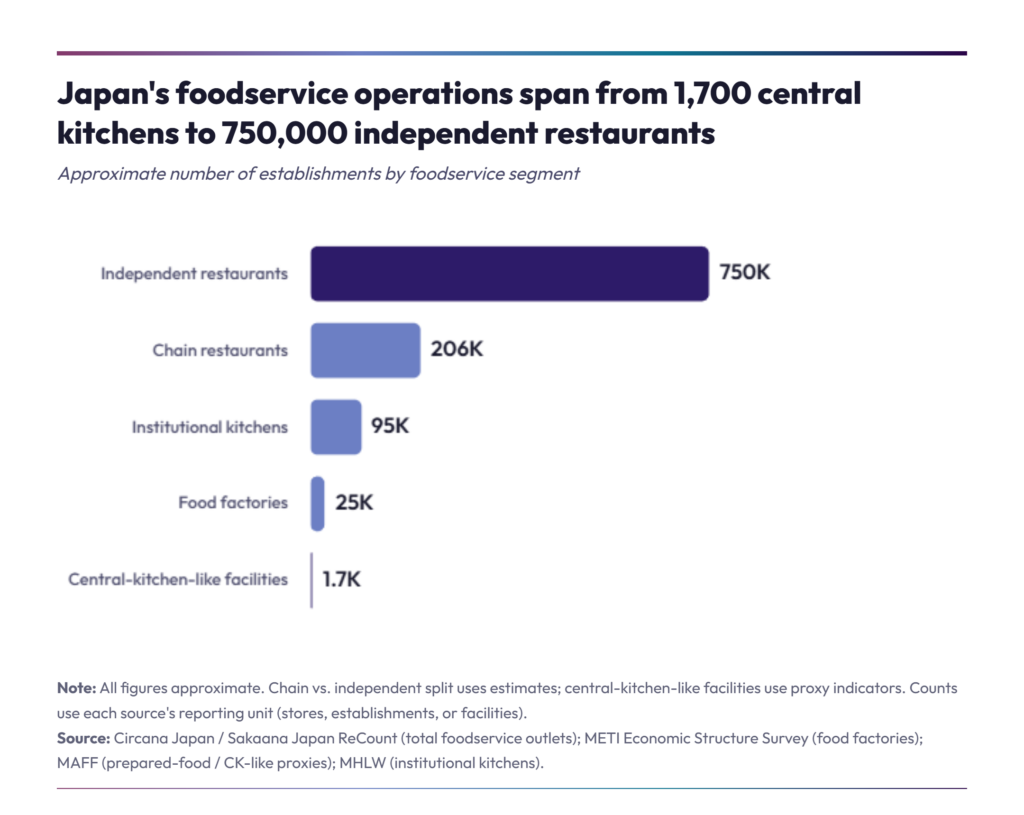
That difference matters because the automation theme also changes by segment. In some environments, the main issue is serving and clearing. In others, it is kitchen standardization, cleaning and hygiene, inventory control, packaging, or inspection. These are not interchangeable use cases, even when they sit under the same broad automation label.
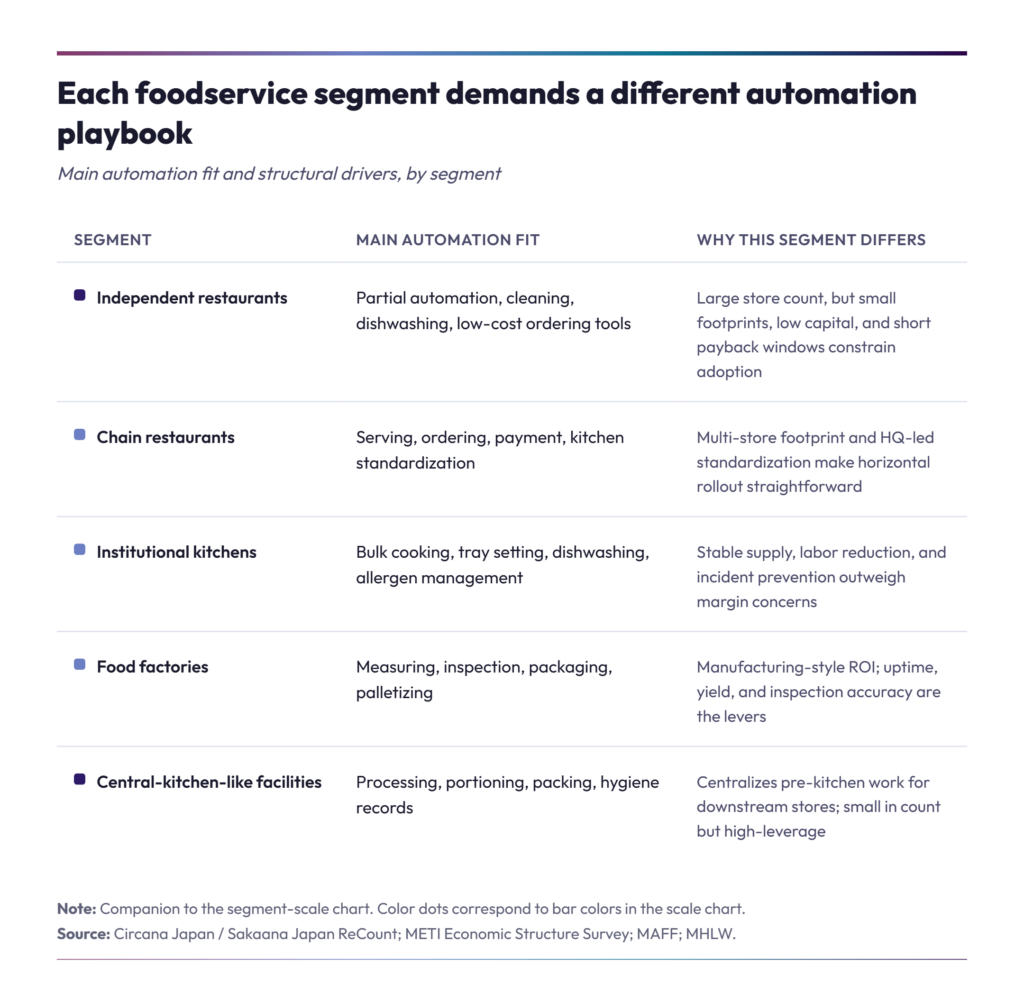
So serving, kitchen work, cleaning, inventory, packaging, and inspection are not really one broad foodservice automation opportunity. Each segment has its own combination of physical constraints, workflow structure, buyer logic, and support requirements. A product that fits one environment well may not transfer easily to another, even within the same country.
Unmet needs: partial automation, cleaning records, and low-maintenance models
The opportunity is not limited to full automation.
In many foodservice environments, the more realistic gap may be partial automation. This can include reducing walking distance, supporting repetitive kitchen work, simplifying cleaning records, assisting inventory checks, or lowering the burden of unpleasant maintenance tasks.
Cleaning and hygiene are especially practical examples. Kitchen floors, grease traps, drains, oil, water, and food residue make the operating environment different from an open commercial floor. A product that works in a hotel lobby or retail facility may still need a different value frame, maintenance model, and support setup to fit a restaurant kitchen.
Inventory and back-office work can also have unmet needs, but the gap is more operational than purely technical. Lightweight sensing, photo or voice-based records, and limited inventory checks for high-impact ingredients may be easier to absorb than a full system that requires heavy master data setup and daily manual input.
So for Japan market entry, the question is where automation can reduce a specific burden without creating new work. Rental and leasing models, low-maintenance design, simple staff training, and clear post-installation support can be just as important as the robot function itself.
Market entry validation areas
Japan market entry is easier to think about through a smaller set of adoption conditions, not one broad market view.
The relevant validation areas include the target segment, physical fit, workflow fit, buyer ownership, maintenance ownership, ROI logic, partner route, and pilot conditions. Each area affects whether automation actually gets used in the field, not just looked at.
| Validation area | What to check |
|---|---|
| Target segment | Whether the product fits large chains, mid-sized multi-store operators, independent restaurants, food factories, or another segment |
| Physical fit | Whether the product can fit into the actual store, kitchen, aisle, washing area, or facility layout |
| Workflow fit | Which task the product replaces, assists, or reduces, and how much human work remains |
| Buyer ownership | Which function owns the budget, evaluation process, and internal approval |
| Maintenance owner | Who handles cleaning, reset, consumables, troubleshooting, and repair response |
| ROI logic | Whether the value comes from labor reduction, table turnover, quality consistency, hygiene, standardization, or another measurable outcome |
| Partner route | Whether the product fits better with a distributor, kitchen equipment company, system integrator, cleaning company, or another partner type |
| Pilot condition | Which format, workflow, and KPI would make a proof of concept realistic |
These checks help separate general demand from actual adoption conditions. For example, a serving robot and a kitchen cleaning system may both sit under foodservice automation, but they involve different physical constraints, buyers, maintenance tasks, and proof points. A food factory automation product needs a different validation path again, with more emphasis on uptime, throughput, washability, and process-specific ROI.
So the practical issue is not really whether Japan has interest in automation. It is more about whether a specific product can fit a specific environment, reduce a specific operational burden, and be supported after installation.
None yet. When we correct this insight, the date and the change appear here.