It sells in Taiwan, so why doesn't it last in Japan?
Your product sells in Taiwan, and Japanese buyers agree to meet you. When that still doesn't lead to an order, or the first order never becomes a second, the cause is often in the conversation: what you ask the buyer, how you answer, and what you send afterward.
Adapted from the webinar for Taiwanese food manufacturers, 21 October 2026. Webinar title: 売れているのに、続かない (English translation: "It sells, but it doesn't last").
You have a strength, which is why your product sells in Taiwan. You know who you want to sell to, which is why Japanese buyers take your meetings and ask for quotes. And still the conversation doesn't turn into the next deal.
My answer to this problem is person-to-person communication. Speaking the same language is not the same as giving the other side what they need to decide.
When I worked as an interpreter, I often thought, "Even if I translate this accurately, it won't come across to a Japanese listener." Some meetings needed a different way of talking, and an interpreter can't change that. So I chose to support overseas companies from a position where I can shape the conversation.
The complaints are about the conversation
The Trade Show White Paper (『展示会白書』), published by 株式会社展示会営業マーケティング in April 2026, asked 1,089 people who visit trade shows in Japan for work what disappointed them about booths. Respondents could choose more than one answer. The survey covers all industries, not only food.
What disappointed visitors about booths (excerpt)
Show as a table
| What visitors said | Share of respondents |
|---|---|
| The hard sell made me stop wanting to listen | 42.4% |
| I asked questions and didn't get an accurate answer | 40.1% |
| The exhibit was much the same as the information on the website | 35.1% |
These are visitors' own answers, not sellers' guesses. None of the three complaints is about the product. Each is about what the booth staff said or showed. You can work hard to explain what you want to say while the visitor never hears what they came to find out.
When a deal stops, I separate three possible reasons:
- The product doesn't meet Japanese needs.
- The Japanese customer is in a different situation from customers in other markets.
- The product and the customer fit, but the communication has stopped.
If the product doesn't fit, conversation alone won't fix it. Before you change the product, though, check whether you have asked about the buyer's situation and given the answers they need to decide. This piece is about the third reason.
Ask what the buyer is trying to do before you explain
Buyers have many products to look at and little time to evaluate them. Repeating what is already on your website wastes that time. In the same white paper, 35.1% of visitors said a booth's exhibit was much the same as its website. So ask first: "How much of our product information have you already seen?" and "What would you like to check today?"
Then find out why the buyer wants to buy, not only what. These four questions take you there:
- Who do you sell to, where, and how?
- What do you use now?
- What problem do you have, and what do you want to change?
- Who decides, and what do they check?
Once you know the buyer's situation, connect your product to it. Compare two openings, both illustrations:
- Before you ask: "This is a popular tea in Taiwan."
- After you ask: "Let's check whether it fits your plan to launch a new menu with the same taste in every store."
One case shows how much the buyer's sales channel changes the answer. Himawari Foods, a company in Niigata, exhibited frozen sushi at the Supermarket Trade Show. Supermarket buyers said the retail price was too high. Gift catalog operators that serve department stores and co-ops said it would sell well at that price. The product was the same. The store and the buying occasion were different, so the reaction to the price was different. The case comes from a case study by NICO, Niigata's industrial creation organization, published in 2026. It is one company's experience, not a measure of how often this happens. So before you rework the pitch, ask where the buyer sells and to whom.
Answer the question the buyer asked
A good reaction is not a purchase decision. When a buyer at a tasting says the product is good, ask: "What else do you need to check before you consider adopting it?" Then answer exactly that.
Supply questions show how this goes wrong. Here is an illustration, with numbers set for the example.
Japanese buyer: "Can you supply 5,000 units a month?"
Taiwanese supplier: "Our current capacity is 3,000 units, but we are expanding, so we can supply without any problem."
What the buyer hears is: not now. The answer doesn't say how the supplier will close the gap of 2,000 units, or when. The supplier meant it as a positive answer, but the buyer can't decide on it. In the white paper, 40.1% of visitors said they asked questions and didn't get an accurate answer.
Answer the same question in four parts. The content is still the illustration.
| Part of the answer | What the supplier says |
|---|---|
| Basis | We plan to raise output to 10,000 units a month for a large order we have already won. |
| Timing | Under that plan, we can supply 5,000 units a month from the month the expansion is complete. |
| Conditions to bring it forward | If you need it earlier, tell us the timing and the quantity. We will check whether we can do it and what it costs. |
| What you confirm with the buyer | If there is an extra cost, at what stage can you commit to the order, and what does your internal approval need? |
Separate what you can do now, what you plan, and what still needs checking. Don't hide what you can't do. One buyer said so directly. At a food buyer round-table run by the Tokyo Chamber of Commerce and Industry, posted on 12 December 2025, 高田浩一 of JALUX said he wants to work with suppliers who can say honestly, "We can do this much." That is one buyer's view, not a survey.
After the show, continue the conversation instead of starting over
The same white paper asked about follow-up after a show. Of the 1,089 visitors, 71.6% said follow-up had left them dissatisfied or stressed. The 780 who were dissatisfied then named what bothered them, with more than one answer allowed, so the table has two bases.
Follow-up after a trade show (excerpt)
Show as a table
| Measure | Base | Share |
|---|---|---|
| Dissatisfied with or stressed by follow-up | All 1,089 visitors | 71.6% |
| Sales contact unrelated to what was discussed at the booth | The 780 dissatisfied | 50.6% |
| Follow-up that came too late, such as weeks afterward | The 780 dissatisfied | 29.6% |
Contact is not automatically a plus. If it has nothing to do with what you discussed, it gives the buyer more work. So pick up where the conversation stopped instead of starting over with your company profile. Both lines below are illustrations.
- Instead of: "Thank you for visiting us the other day. Let me introduce our company."
- Write: "Here is what you asked for about launching the new menu in all your stores."
To write that email, record what a business card doesn't: the buyer's business and problem, who decides and when, what they asked for, which questions you didn't answer, and what you promised. Then send exactly what was requested. Answer the open question before you add anything new. End with who does what, by when.
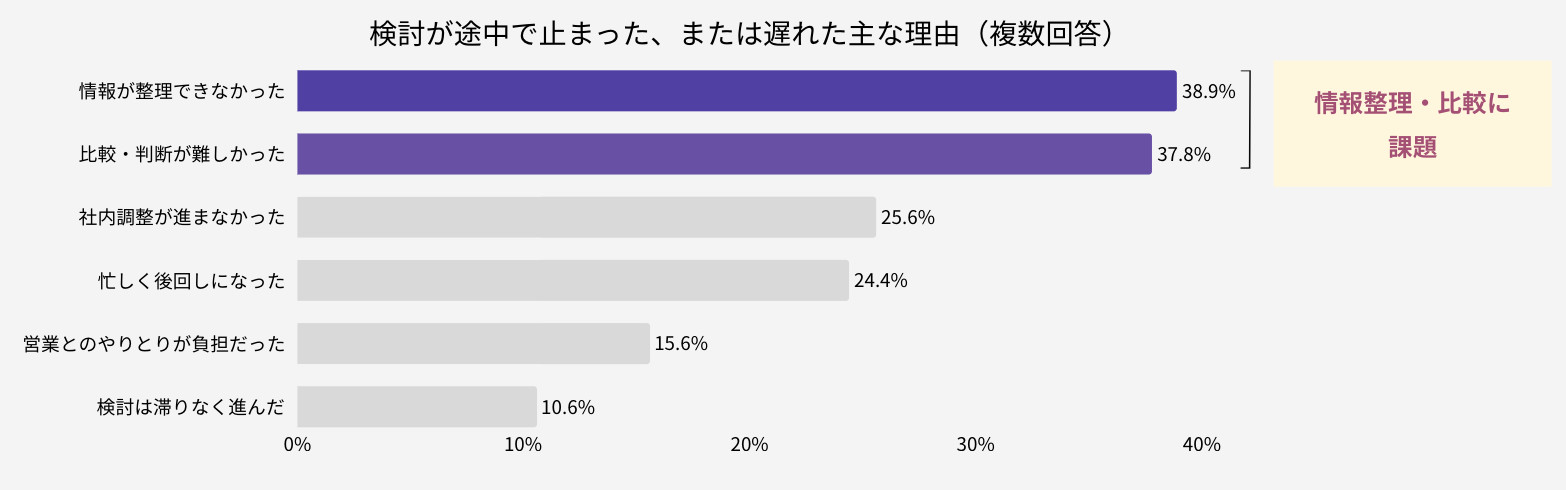
Information alone doesn't move a decision. NK Energy System Co., Ltd. (株式会社エヌケーエナジーシステム) surveyed 180 people involved in introducing or reviewing business services or tools in the previous 12 months, on 9 to 11 January 2026. It asked why a purchase review had stalled or slowed down. Respondents could choose more than one answer, and the survey is not about food.
Main reasons a purchase review stalled or slowed (excerpt)
Show as a table
| Reason | Published share |
|---|---|
| We couldn't organize the information | 38.9% |
| Comparing and deciding was hard | 37.8% |
Work remains between receiving information and being able to decide. Lay out what has been confirmed and what hasn't. Ask what the buyer is comparing you with, and on what terms.
Timing matters too. In the white paper, 29.6% of the dissatisfied visitors named late follow-up. That doesn't set a correct number of hours. Meet the buyer's timeline and any deadline you promised at the booth.
Keep the promises you make
Do what you said. If you said you would send samples on Friday, send them on Friday. If you will be late, tell the buyer before they ask, with the new date. The buyer has promises of their own to keep, to colleagues and to customers.
AI makes it easier to research companies and prepare outreach. Getting a meeting and building business with the buyer are still different jobs. In the end, a person decides: can I get work done with this supplier?
A long relationship also becomes a barrier to entry. A new competitor can offer a product and a price. It can't quickly build a history of understanding the buyer's situation and solving problems together. A relationship doesn't sell a product that doesn't fit. When the product fits and you are easy to work with, the relationship is what leads to repeat orders.
So think of one deal that has stalled. What haven't you asked about the buyer's situation? Which question haven't you answered? Who needs to do what next for it to move? Start by checking one of these.
Three challenges registrants selected
The registration form asked attendees to choose their challenges from a fixed list of eight. Here are my answers to three of them.
"Our quotes don't fit"
First, check whether price is really the only problem. Have you heard and understood what the buyer wants besides price? At least, there is no buyer data showing that price is the problem. The price problem that does come up is rising raw material costs, which is a price problem after the purchase. A commodity is different. There, competition is on price, and the work is on your costs.
"We can't find the right importer or distributor"
The order is often reversed. First, research what importers and distributors are struggling with. Then explore whether your product can solve it. That takes homework before you contact them, and buyers value that homework. Without it, you can look as if you are pushing the sales risk of your new market entry onto the buyer.
"Our production capacity is short, or our supply isn't stable"
This is a chicken-and-egg problem, and a very hard one. Expanding capacity before the deal is firm is something you want to avoid, unless you have the money for it. But you can be ready. Don't say "we can". Prepare a document that says honestly: if the contract is confirmed, we are ready to carry out this specific expansion plan at the same quality. If needed, offer a tour of the plant you would use. If the buyer really wants the product, they will work it out internally and make concessions, even if their terms get stricter.
Sources
Surveys. Neither is limited to food buyers.
- 株式会社展示会営業マーケティング, 『展示会白書』 (Trade Show White Paper), April 2026. Business visitors to trade shows, n=1,089, internet survey. Booth complaints: figure 5-10, multiple answers. Follow-up: figures 5-15 and 5-16, 71.6% single answer of n=1,089, complaints multiple answers of n=780. Figure list, chapter 5-1, chapter 5-2.
- 株式会社エヌケーエナジーシステム (NK Energy System Co., Ltd.), 『BtoB購買プロセスと営業接点の実態調査』, 9 to 11 January 2026. 180 company staff involved in introducing or reviewing business services or tools in the previous 12 months, internet survey, multiple answers. Release, figure of reasons.
Case and buyer comment. Each shows one company or one person, not a pattern across buyers.
- にいがた産業創造機構 (NICO), case study of Himawari Foods. Case page.
- 東京商工会議所 (Tokyo Chamber of Commerce and Industry), 『【販路開拓+α】今、バイヤーが求めているもの(食品バイヤー座談会)』, page posted 12 December 2025. Remarks by 高田浩一 of JALUX. Page.
The tea and new-menu lines, the 5,000-unit supply exchange, and the follow-up email lines are illustrations. They are not real clients or records of a specific meeting.
None yet. When we correct this insight, the date and the change appear here.
More insights
- InsightWhere 17 AI answers would put a food factory in Japan, and the subsidy rules behind them
- InsightJapan Trade Show Segment Classification
- InsightFoodservice Automation in Japan: Adoption Conditions for Overseas Robotics Companies
- InsightThe three things restaurants check before taste when considering a new ingredient