Hire a fractional team.
No need for a full-time team, but need someone to help on the ground? That's us. Strategy, sales, marketing, product feedback, customer success, and partner management. You start small, stay flexible, and only commit more once you see it working. We agree the scope together in the first call.

- $1,500to $5,000 a month, agreed with you on a free call
- 1standing engagement. The scope moves with the problem.
- 0change orders when the bottleneck moves
- 0long-term lock-in. Start small, commit more when it works.
The scope follows the problem.
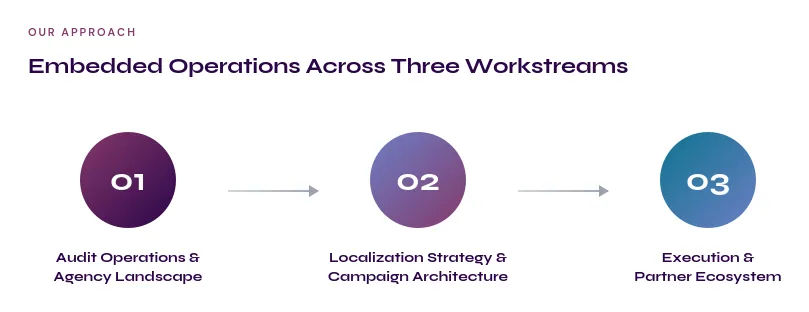
Japan entry doesn't respect functional boundaries. The bottleneck moves: from research to outbound, from marketing to product feedback, from closing to onboarding. Most engagements can't follow it, because the scope was frozen at signing.
Execution is built for that movement. It is one standing engagement that shifts to wherever the constraint is this month, with no change order. You're not buying a task list. You're buying a team that follows the problem.
What we can take on.
Most companies need a few of these at a time, and the mix changes. Treat this as a range, not a package.
- Sales
Sales on the ground
Qualified meetings with buyers who fit, and deals that move forward. The same team that gets the meeting handles the follow-ups, proposals, and technical back-and-forth.
- Customer success
Customer success in Japanese
Renewals and post-deployment care. Deployed customers get checked on before they go quiet.
- Product
Product feedback to your HQ
Japan-market requirements, reported in the market's own words.
- Marketing
Marketing
Localization, events, content, and lead generation.
- Partners
Partner management
The partner you already have, made to sell.
- Research
Research and strategy
Your monthly research continues inside the engagement. Pricing, positioning, and channel decisions use what the market said this month.
Every buyer goes through the same steps.
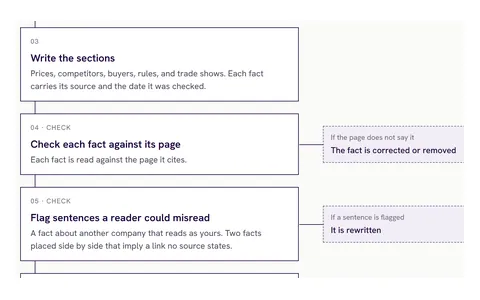
Each company and each person gets researched before anyone writes to them. Nothing goes out until we decide to send it.
- 01
Company brief
Why the company may fit, the routes in, and the next move.
If it is on your do-not-contact list: no message is written. - 02
People brief
Who decides, what they are responsible for, and what they have said in public.
If the brief has gaps: more research first. - 03
Message options
A few ways to open the conversation, each built on what the person has said in public.
- 04 Check
Each option assessed
Each option is rated against the goal of this conversation, not the eventual sale.
If the timing is wrong: wait, with a date to look again. - 05 Review
We decide and send
We pick the message and send it by hand.
If it needs more work: back to step 03. - 06
A reply, or a date to follow up
A reply starts the conversation. Without one, the person gets a set date to revisit, not a chase.
The tracker checks that every sent message is kept word for word, and that everyone waiting for a reply has a date to revisit.
What running the market looks like.
Three things that happen inside an engagement, and not inside a one-time report.
A relationship carried past the first meeting
A qualified meeting is a start, not a finish. The team that got you the meeting keeps it moving, instead of handing off to whoever is free that week.
A renewal saved before it became a problem
Usage, satisfaction, and the renewal conversation happen on a schedule, not only when something has already broken.
A go or no-go call made with real market feedback
Decisions use what the market actually said this month, not a one-time report written in year one and never revisited.
Our previous projects
Dorado's own work in Japan, written up with the client anonymized: the problem, what we did, and what changed. All use cases.
Start small.
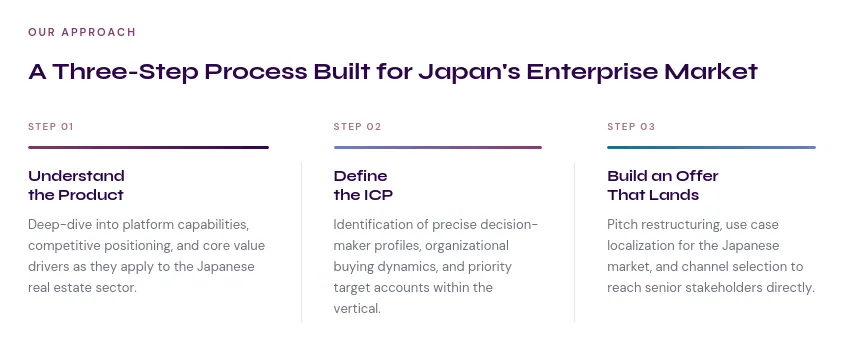
Tell us the goal through the contact form: what you want to happen in Japan. On a free call we agree the scope and where the monthly figure lands. No charge until you say yes. Begin with the function that holds you back now, and add functions once you see results.
- One standing engagement
- The scope moves with the problem
- Research continues inside it
- Run in English and Japanese
- No long-term lock-in
- Spot work any time, $65 per 30 minutes or $400 a day, if you need one task done

Before working with us.
Who does the work?
We run every engagement ourselves, in English and Japanese, and read every brief before it is sent.
Do I need the research plan first?
No. Research continues inside execution, so you can start there. The research plan is a cheaper way to get to know how we work first.
When does execution start?
When you decide to. We agree the scope and the monthly figure on a free call first, and the research continues inside the engagement.
Could spot work be enough?
If you need help with a task now and then, yes. Spot work is $65 per 30 minutes or $400 a day, any time. At about 12 hours a month, spot work costs $1,560, which is about where execution starts. Read about spot work.
Why a range for execution, not a fixed price?
Where you land between $1,500 and $5,000 a month depends on your product, your targets, and your stage. We agree the figure in the first call.
Is there a minimum term?
No. Execution has no long-term lock-in: start small and commit more once you see it working.
Before execution, and who runs it.
Validate the fit.
Research on your product and its buyers in Japan, checked in Tokyo. Up to 5 written questions. Cancel any month.

The person you'll actually work with.
Minoru Shiina runs every engagement personally. 15+ years in the Japan market. English, Japanese, and Mandarin.