
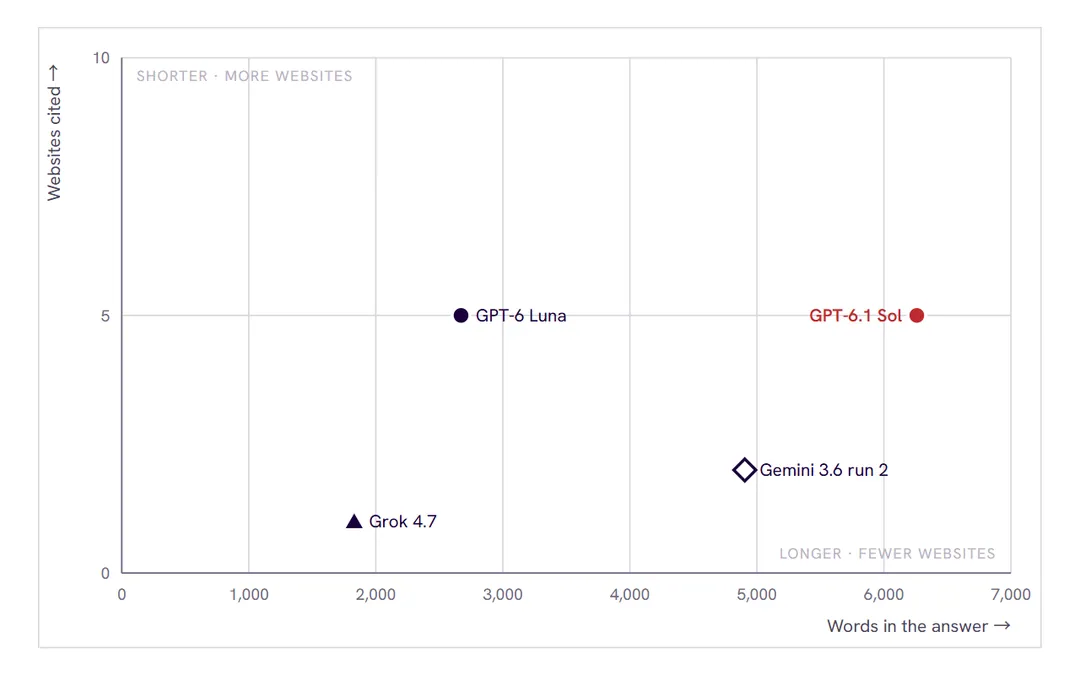
Which AI model searches the web better on an izakaya customer-complaint question?
We gave five AI models the same long research brief with web search on, and Gemini 3.6 answered twice. This page counts the websites each answer cites and sets that against the answer's length. We have not yet opened the cited links to see whether they back the answers. It compares the models, not their advice.
As asked, word for word.
ROLE
You are a qualitative market researcher who reads Japanese fluently. You analyze user-generated content (UGC) about restaurants in Japan.
OBJECTIVE
Find out what customers in Japan complain about when they visit izakaya, using ONLY user-generated content. Then work out what operational struggles those complaints reveal on the izakaya side. The end use is finding products or services that could be sold to izakaya operators to fix those struggles.
PARAMETERS
- Time window: {{2024-10-01}} to {{2026-10-04}}
- Geography: Japan (all regions; note region when the source states it)
- Report language: {{English}}. Keep every quote in its original language and add a translation.
SOURCE RULES (strict)
ALLOWED, posts written by individual customers only:
- Review sites: 食べログ, Google Maps reviews, Retty, ホットペッパーグルメ口コミ, 一休, TripAdvisor
- Social media and forums: X (Twitter), Instagram comments, Threads, YouTube comments, Yahoo!知恵袋, 発言小町, ガールズちゃんねる, 5ch, Reddit (r/japanlife, r/japan, r/JapanTravel), note (personal posts only)
EXCLUDED (do not use as evidence, even if they quote reviews):
- News articles, industry reports, surveys, statistics, consultancy or vendor blogs, PR, restaurant-owned accounts, listicles ("居酒屋の嫌なところ10選" summaries), and any AI-generated summary (including review-site AI summaries)
If you cannot open a source and read the original post yourself, do not cite it. If you have no browsing access, say "NO BROWSING" at the top and stop. Do not answer from memory.
SEARCH GUIDANCE
Search mainly in Japanese. Treat these as starting points, not limits: 居酒屋 最悪 / 居酒屋 二度と行かない / お通し 不満 / 席料 チャージ 知らなかった / 飲み放題 ラストオーダー 早い / 料理 出てこない 居酒屋 / 店員 態度 居酒屋 / モバイルオーダー 居酒屋 不便 / タッチパネル 注文 / 居酒屋 うるさい 狭い / 居酒屋 タバコ 臭い / 予約 取れない 居酒屋 / 会計 間違い 居酒屋 / 2時間制 追い出された Also search in English for complaints from foreign visitors. Cover chain izakaya and independent izakaya, and say which one each piece of evidence concerns.
METHOD
1. Collect complaint posts. Aim for 40 or more distinct posts from at least 4 different platforms. Do NOT pad. If you find fewer, report the real number.
2. Group the complaints into themes. Map every theme to exactly ONE of these fixed domains so the results can be compared: D1 Food quality/portion | D2 Drinks/飲み放題 rules | D3 Staff attitude/service D4 Speed/wait times | D5 Ordering system (tablet/QR/mobile order) | D6 Price/billing/お通し/charges | D7 Seating/space/noise | D8 Smoking/smell | D9 Cleanliness/hygiene | D10 Reservations/time limits | D11 Payment methods | D12 Foreign-visitor/language | D13 Other (explain)
3. For each theme, separate three layers and never mix them: - OBSERVED: what the users actually said (backed by quotes) - INFERRED: the operator-side struggle that likely causes it (for example, a labor shortage that causes slow service). Label it as inference. - OPPORTUNITY: what kind of product or service could address it. Label it as speculation.
OUTPUT FORMAT (follow exactly)
0. Run metadata
Model name, browsing/research mode, date run, number of posts reviewed, platforms used.
1. Evidence table
One row per post:
| ID | Platform | URL | Post date | Venue type (chain/independent/unknown) | Region | Domain | Original quote (verbatim, max 2 sentences) | Translation |
IDs: E01, E02, ... Copy quotes exactly. Do not paraphrase inside the quote column. If the post date or region is not shown, write "unknown". Do not guess.
2. Complaint themes (ranked by number of supporting posts in YOUR sample)
For each theme:
- Theme name / Domain code
- Supporting evidence IDs (e.g. E03, E11, E27) and the count
- OBSERVED: 2-3 sentence summary
- Severity signal: does it cause "never coming back", lower star ratings, or only mild annoyance? Cite IDs.
- INFERRED operator struggle: [inference] ...
- Confidence: High / Medium / Low, with a one-line reason
Do not state percentages or claim anything about the whole population. Counts describe your sample only.
3. Operator struggle map
| Struggle (inferred) | Themes it explains | Evidence IDs | Confidence |
4. Sales opportunity hypotheses
| Struggle | Solution category | Why the complaints suggest the izakaya would pay for it | Counter-evidence or risk |
Label every row [speculation]. Do not name vendors unless asked.
5. Self-audit
- Claims you are least sure about
- Platforms you could not access or search well
- Possible biases in the sample (for example, angry reviewers are over-represented, or tourist-area venues dominate)
- Anything you EXCLUDED because it was not genuine UGC
6. Machine-readable summary
A JSON block in this shape: {"model":"","run_date":"","posts_reviewed":0, "themes":[{"name":"","domain":"D1","evidence_ids":[],"count":0,"confidence":"High"}], "struggles":[{"name":"","theme_names":[],"confidence":"Medium"}]}
ACCURACY RULES
- Every factual statement in sections 2 and 3 must cite evidence IDs.
- Never invent a URL, quote, date, or reviewer. If you are unsure that a quote is exact, leave it out.
- Prefer fewer, verified items over many unverified ones.
The brief is long and strict. It allows only posts written by individual customers, on review sites and forums, and it bans news, surveys, and vendor blogs. It asks for 40 or more posts from at least 4 platforms, and says to report the real number if the model finds fewer. It tests whether a model finds and quotes original posts, and whether it says so when it cannot.
Which model researched further?
Show as a table
| Answer | Words | Websites cited |
|---|
More websites means the model looked further. It does not mean the answer is right. That needs the link check below, which has not run for this question.
Do the cited pages back what the models wrote? Not checked yet.
In a checked comparison, we open every cited link and compare the page with the passage that cites it. For this question that has not happened. The numbers below say how much there is to check.
Cited links · one square per link, none opened yet
Until then, treat every figure in these answers as a lead, not a fact. Open the page before a number goes into your plan. To see what a finished check looks like, read the comparison How effective are interpreters and translation tools at trade-show booths in Japan?.
What this means when you pick a model for research.
The brief asks for posts, and websites undercount them.
One website can hold many posts. GPT-6.1 Sol's saved copy has 40 links on 5 websites. The count lists tripadvisor.com and tripadvisor.jp as two websites.
Only one answer reports reaching the target of 40 posts.
These are the answers' own run notes, and we have not checked them. GPT-6.1 Sol reports 40 posts, Gemini 3.6 run 2 reports 23, GPT-6 Luna reports 14, Grok 4.7 reports about 12 to 15, and Pro reports 3.
Gemini 3.6 gave opposite results on its two runs.
Run 1 is 118 words. It prints "NO BROWSING" and stops, although the record shows web search on. Run 2 is 4,905 words and reports 23 posts from Yahoo! Chiebukuro and Reddit.
Pro's addresses are cut short.
Pro reports 3 posts. Its table column is headed "URL (partial)", and its addresses end in "...", such as forum.tripadvisor.in/ShowTopic... They are not complete addresses, so the library counts 0 links.
Every answer, with its numbers.
| Model | Setting | Asked | Words | Websites | Links |
|---|---|---|---|---|---|
| GPT-6 Luna | High | 5 Oct 2026 | 2,671 | 5 | 13 |
| GPT-6.1 Sol | High | 5 Oct 2026 | 6,259 | 5 | 40 |
| Pro | Pro | 5 Oct 2026 | 1,062 | – | |
| Gemini 3.6 | Thinking | 5 Oct 2026 | 118 | – | |
| Gemini 3.6 | Thinking | 5 Oct 2026 | 4,905 | 2 | 25 |
| Grok 4.7 | Fast | 5 Oct 2026 | 1,830 | 1 | 7 |
More model comparisons
- Model comparisonWhat sourcing pains does Kato Sangyo face?
- Model comparisonHow effective are interpreters and translation tools at trade-show booths
- Model comparisonMaruto Mizutani: customer segments, strengths, weaknesses, and issues requiring outside help
- Model comparisonBuyer's journey in Japan's food retail and wholesale space