Qwen3.7-Plus at Thinking, asked 9 Oct 2026
One answer from the comparison, shown in full as the model produced it on 9 October 2026. Nothing is edited. Its 10 cited links were opened and graded on 31 October 2026: 2 of 10 cited passages are fully backed. The comparison explains the check.
Japan Food Product RFQ Strategy & Source Links
Strategic Overview
Winning a Request for Quotation (RFQ) in Japan's food retail and wholesale sector requires more than just competitive pricing. With an existing OEM production center in Japan, you already possess a massive competitive advantage: supply chain reliability, faster replenishment, and the coveted "Made in Japan" quality perception (source, 2026-10-09) [9].
1. Japanese Business Culture & Negotiation Nuances
- Nemawashi (Consensus Building): The formal RFQ is often just the final step. The real decision-making happens through informal, behind-the-scenes consensus building (source, 2026-04-21) [2].
- Long-Term Orientation (Shinyo/Trust): Japanese buyers prioritize reliability, consistency, and long-term partnership over short-term cost savings. Negotiations emphasize harmony and indirect communication (source, 2026-04-08) [3].
- Documentation Perfection: Quotations must be flawless, ideally bilingual (Japanese/English), and highly detailed. Any error can be perceived as a lack of seriousness or operational risk.
2. Specific Food Industry RFQ Requirements
- Traceability & Food Safety: Japan enforces a strict "Positive List System" for agricultural chemical residues. Detailed lot-to-lot traceability documentation and change control carry the most weight in long-term supplier evaluations (source, 2026-09-28) [4].
- Packaging & Labeling: Compliance with the Food Sanitation Act is mandatory. Furthermore, there is a massive industry shift toward sustainable, biodegradable, or minimal packaging due to Extended Producer Responsibility (EPR) policies and recycling mandates (source, 2024-07-01) [90].
- Delivery Precision: The Japanese distribution system expects frequent, small-lot, Just-In-Time (JIT) deliveries. Packaging consistency and barcode accuracy are considered fundamental parts of delivery quality (source, 2025-11-18) [84].
3. "Wacky" but High-Value Ideas to Outsmart Competitors
Note: In Japan, "wacky" must not mean "risky." It should mean "unexpectedly thoughtful and highly value-adding."
- Blockchain-Enabled "Story" QR Codes: Go beyond basic compliance. Provide QR codes on packaging that allow consumers to scan and see the exact farm source, OEM batch details, and a short video of the production line. Blockchain-enabled traceability is increasingly adopted in Japan to align with stringent safety standards and boost consumer trust (source, 2025-06-01) [97]. This gives retailers a unique, premium marketing angle.
- Dynamic "Green" Pricing Tiers: Offer a tangible discount if the retailer/wholesaler opts for consolidated deliveries or eco-friendly packaging (e.g., polylactic acid disposable containers). This aligns perfectly with Japan's 2025–2026 sustainability mandates and reduces the buyer's carbon footprint reporting burden (source, 2026) [87].
- Co-Creation "Sandbox" at the OEM: Invite the buyer’s product development team to your Japanese OEM facility for a quarterly "innovation lab." Offer fast-track prototyping for exclusive, seasonal flavors. This turns you from a vendor into a strategic innovation partner, directly addressing the wholesale industry's urgent need to provide added value to retailers (source, 2023-01-10) [80].
- AI-Driven Predictive Replenishment: Offer to integrate with their inventory system to auto-suggest orders based on weather forecasts, local events, and historical sales data. Top strategies for gaining a competitive edge in wholesale now include predictive inventory and tighter supplier collaboration (source, 2025-07-22) [78].
- "Zero-Risk" Sell-Through Guarantee: A bold but calculated move. State: "If the first 3 shipments don't meet a mutually agreed-upon sell-through rate, we will fund a localized in-store marketing campaign or buy back the unsold inventory." This demonstrates extreme confidence and removes the buyer's perceived risk.
4. Actionable Next Steps for Your Quotation
- Structure: Include a detailed breakdown of costs (FOB/CIF), Minimum Order Quantities (MOQ), lead times, and payment terms.
- Certifications: Attach all relevant quality assurance documents (ISO, HACCP, JAS if applicable).
- Localization: Ensure the final document is professionally translated into business Japanese (Keigo).
- Follow-up: Plan a face-to-face or high-quality video meeting to present the quotation, emphasizing your commitment to a long-term relationship.
Source Links
[2] First Agri: Matcha Wholesale Negotiation Playbook 2026 - https://first-agri.jp/matcha/columns/046 (2026-04-21) [3] MindMelt: Japan B2B Sales Strategy for Foreign Companies - https://mindmelt.jp/insights/japan-b2b-sales-strategy (2026-04-08) [4] Reliance Pak: Food-Contact Packaging Compliance & Sourcing Guide - https://reliancepak.com/blog/food-safe-plastic-containers-ensuring-quality-safety-and-compliance/ (2026-09-28) [9] AI Report Library: Food quotations for Japanese retailers and wholesalers - https://aireportlibrary.com/en/prompt/japan-food-quotation/pricing/compare/ (2026-10-09) [78] VAI: Top Strategies for Gaining a Competitive Edge in the Wholesale Food Industry - https://www.vai.net/resources/blog/top-strategies-for-gaining-a-competitive-edge-in-the-wholesale-food-industry (2025-07-22) [80] Mitsui & Co. Global Strategic Studies Institute: Wholesale Industry Trends to Enhance Its Significance - https://www.mitsui.com/mgssi/en/report/detail/__icsFiles/afieldfile/2023/01/10/2211i_takashima_e.pdf (2023-01-10) [84] U.S. Commercial Service: Japan - Selling Factors and Techniques - https://www.trade.gov/country-commercial-guides/japan-selling-factors-and-techniques (2025-11-18) [87] LinkedIn: Japan Biodegradable Food Packaging Market Forecast - https://www.linkedin.com/pulse/japan-biodegradable-food-packaging-market-elxwf (2026) [90] MDPI: Current Status of Sustainable Food Packaging Regulations - https://www.mdpi.com/2071-1050/16/13/5554 (2024-07-01) [97] ScienceDirect: Blockchain-based food traceability system and green consumer trust - https://www.sciencedirect.com/science/article/pii/S2666784325001196 (2025)
End of the answer. AI-generated, unverified. Asked 9 Oct 2026.
10 websites, 10 links.
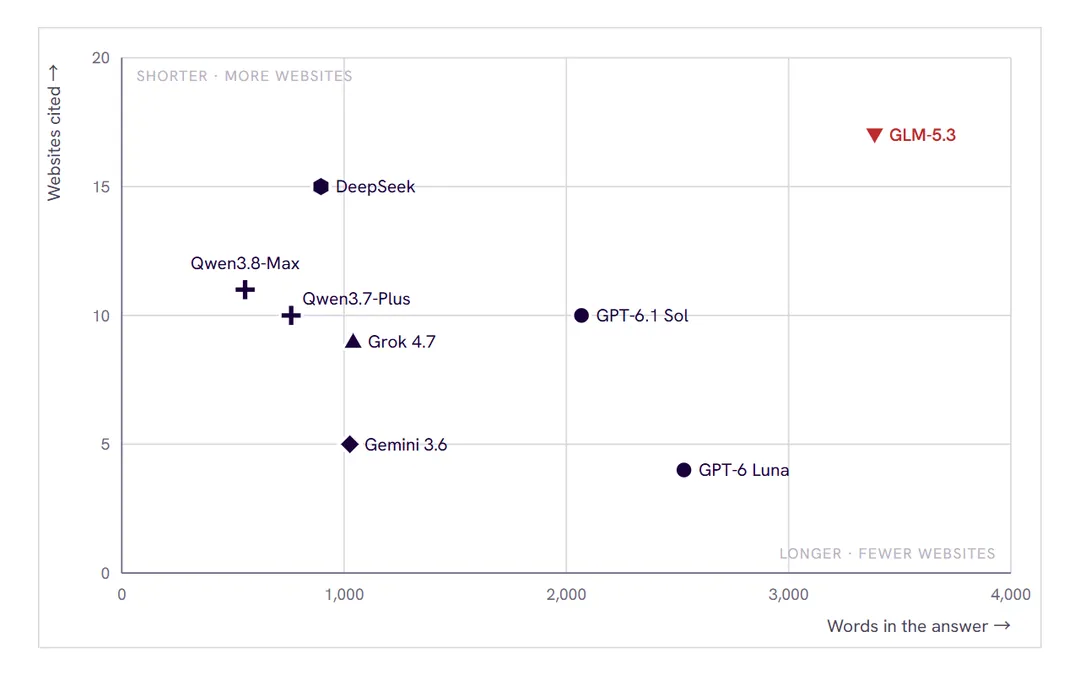
The same count the comparison's density chart uses. A website is a distinct hostname.
| Website | Links |
|---|---|
| aireportlibrary.com | 1 |
| first-agri.jp | 1 |
| linkedin.com | 1 |
| mdpi.com | 1 |
| mindmelt.jp | 1 |
| mitsui.com | 1 |
| reliancepak.com | 1 |
| sciencedirect.com | 1 |
| trade.gov | 1 |
| vai.net | 1 |
Read another answer.
| Model | Setting | Asked | Words | Websites |
|---|---|---|---|---|
| GPT-6 Luna | High | 9 Oct 2026 | 2,529 | 4 |
| GPT-6.1 Sol | High | 9 Oct 2026 | 2,068 | 10 |
| Gemini 3.6 | Thinking | 9 Oct 2026 | 1,026 | 5 |
| Grok 4.7 | Fast | 9 Oct 2026 | 1,041 | 9 |
| Qwen3.8-Max | Thinking | 9 Oct 2026 | 555 | 11 |
| DeepSeek | DeepThink | 9 Oct 2026 | 896 | 15 |
| GLM-5.3 | Not selected | 9 Oct 2026 | 3,387 | 17 |