
Which AI model searches the web better on a Japanese food-quotation question?
We gave eight AI models the same question about quoting food products to a Japanese retailer and a wholesaler. This page measures how far each answer searched and whether the pages it cited back what it wrote. It compares the models, not their advice.
As asked, word for word.
we received a request for quotation from both retailer and wholesaler in Japan for our food products, which we already have an OEM production center in Japan. I know basic quotation terms and conditions, but anything particular things and business culture that I have to be carefully aware of?
I want to outsmart our competitors including domestics ones, so search and suggest me the best options possible. I'm open to WACKY ideas as long as it brings significant value to the retailer and wholesaler.
Output condition
- Include fact links after the paragraph or sentence
The question asks for Japanese business culture and for ideas that beat competitors. Rules on payment, returns, and delivery are published by Japanese government and trade bodies. The ideas are the model's own. It tests whether a model finds the pages on trade practice and keeps its own proposals apart from what those pages say.
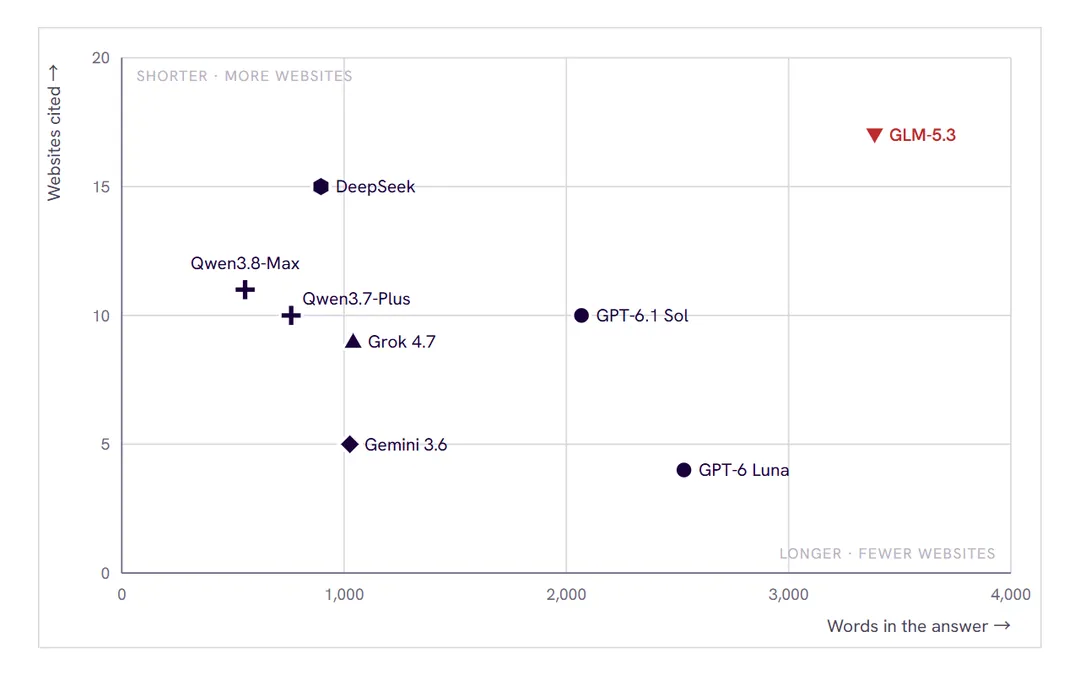
Which model researched further?
Show as a table
| Answer | Words | Websites cited |
|---|
More websites means the model looked further. It does not mean the answer is right. The next chart checks that.
Which answer holds up as written?
We opened every cited link and compared the page with the passage that cites it. A passage is backed when every figure, name, date, and condition in it is on the page.
What the check caught
- DeepSeek: a Korean rule given as Japan's.It says imported OEM products must show an OEM label beside the country of origin. The Consumer Affairs Agency document it cites describes South Korea's labeling system. It also gives center fees as 10 to 15% of the price and says 52.5% of supermarkets ask for them. The 2013 Japan Fair Trade Commission report it cites has neither figure, and its other source would not open.
- GLM-5.3: right page, wrong reader.Two passages quote First Agri columns, and the pages do say it: volume discounts from 0 to 5% up to 28 to 35%, and 100% advance payment on the first orders. Those columns describe the terms matcha suppliers give overseas buyers. GLM-5.3 presents them as typical Japanese food wholesale pricing and payment terms.
- Gemini 3.6: no passage fully backed.Its four passages cite five pages, and two of them are about something else. A foodservice market report is cited for shelf-ready packaging and staff training in retail. A guide to finding a distributor is cited for the sustainability targets of Seven & i and Aeon.
- Qwen3.7-Plus: AI citing AI.One passage, which says an OEM plant is an advantage, rests only on the AI Report Library's page for this question. That page shows other AI answers. Another passage cites a U.S. Commercial Service guide for small-lot, just-in-time delivery, which the guide does not discuss.
What this means when you pick a model for research.
Breadth and backing did not go together.
GPT-6 Luna at High cited 4 websites, and 18 of its 20 passages hold up in full. DeepSeek cited 15, and 3 of its 14 do. GLM-5.3 cited 17, and 27 of its 39 do. The website count says how far a model looked, not what the pages say.
A list at the end is hard to check.
Grok 4.7 and Qwen3.7-Plus put their links in a source list. The list ties an entry to a claim only by domain name or reference number. 4 of their 19 passages hold up in full, against 63 of 97 in the six answers that link beside the claim. Ask for the link beside each claim.
Pages go missing.
Three weeks after the answers were asked, four cited pages return 'not found'. DeepSeek and GLM-5.3 have two such passages each. Another 12 passages cite pages we could not open.
A match is not a fit.
The check grades whether a page carries the text. It does not grade whether the text applies to a food supplier quoting a Japanese retailer. Check who a page was written for before you rely on its figure.
Every answer, with its numbers.
| Model | Setting | Words | Websites | Passages checked | Backed | Partly | Not backed |
|---|---|---|---|---|---|---|---|
| GPT-6 Luna | High | 2,529 | 4 | 20 | 18 | 1 | 1 |
| GPT-6.1 Sol | High | 2,068 | 10 | 15 | 14 | 1 | 0 |
| Gemini 3.6 | Thinking | 1,026 | 5 | 4 | 0 | 2 | 2 |
| Grok 4.7 | Fast | 1,041 | 9 | 9 | 2 | 7 | 0 |
| Qwen3.8-Max | Thinking | 555 | 11 | 5 | 1 | 3 | 1 |
| Qwen3.7-Plus | Thinking | 762 | 10 | 10 | 2 | 3 | 5 |
| DeepSeek | DeepThink | 896 | 15 | 14 | 3 | 6 | 5 |
| GLM-5.3 | Not selected | 3,387 | 17 | 39 | 27 | 3 | 9 |
More model comparisons
- Model comparisonTaiwan-to-Japan alcohol export pricing: work backward from Japanese market prices to preserve profit
- Model comparisonTop 10 e-commerce channels in Japan for overseas food providers: 6–12 month total project costs
- Model comparisonTop 5 locations in Japan for food manufacturing, including subsidies
- Model comparisonWhich companies in Japan are most similar to KALDI Coffee Farm?