
Which AI model searches the web better on a Japan daily food demand question?
We asked five AI models the same question and kept one answer from each. Web search is recorded as on for four of the five. The record for Grok 4.7 does not say. This page counts the websites each answer cites. It does not open the links, so it cannot say whether the pages back what the answers wrote. It compares the models, not their advice.
As asked, word for word.
Research Japanese daily food demand? Not a fad, but food product or spices that blend into the daily life in Japan, so that the demand becomes constant.
If it's hard to find as solid fact, change the angle to search the actual cases that became a daily use/consumption food.
My goal here is to identify the long tail demand or cases, so that I can integrate those insights into our strategy planning of the product.
Output condition
- Include fact links after the paragraph or sentence
The question asks for foods and spices that people buy every day, not fads, and allows a fallback to real cases when solid figures are hard to find. Much of the data, such as household surveys and trade statistics, is published in Japanese. It tests how widely a model searches before it falls back to cases.
Which model researched further?
Show as a table
| Answer | Words | Websites cited |
|---|
More websites means the model looked further. It does not mean the answer is right. That needs the link check below, which has not run for this question.
Do the cited pages back what the models wrote? Not checked yet.
In a checked comparison, we open every cited link and compare the page with the passage that cites it. For this question that has not happened. The numbers below say how much there is to check.
Cited links · one square per link, none opened yet
Until then, treat every figure in these answers as a lead, not a fact. Open the page before a number goes into your plan. To see what a finished check looks like, read the comparison How effective are interpreters and translation tools at trade-show booths in Japan?.
What this means when you pick a model for research.
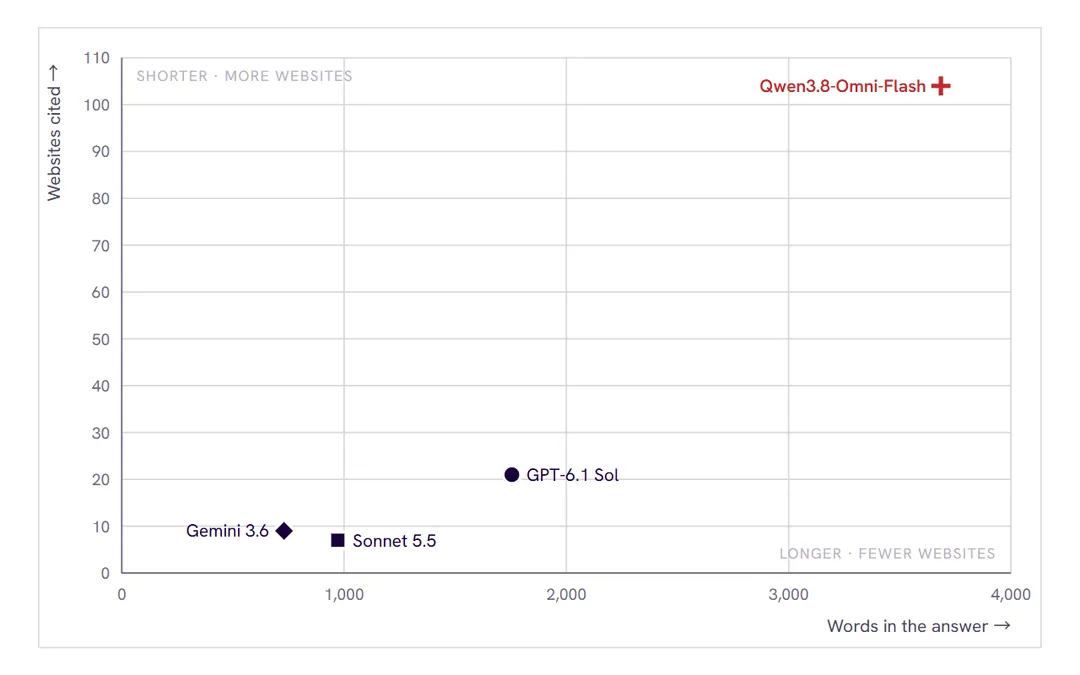
One answer cites about five times as many websites as the next.
Qwen3.8-Omni-Flash cites 104 websites in 3,685 words. GPT-6.1 Sol is next with 21. Qwen3.8-Omni-Flash writes its sources as web addresses in parentheses and leaves many source phrases and figures in Japanese.
Two answers say daily demand is not published as one figure.
Sonnet 5.5 says solid statistics are thin and switches to cases, as the question allowed. Qwen3.8-Omni-Flash says it rebuilt the figure from three proxies: supply per person, how often people eat the food, and category sales that keep setting records.
Each answer picks different cases.
Gemini 3.6 builds on four condiments: Taberu Rayu, mentsuyu, shio koji, and yuzu kosho. Grok 4.7 starts from Kewpie mayonnaise, curry roux, and furikake. GPT-6.1 Sol starts from a natto survey and then covers kimchi.
The link gaps differ.
Grok 4.7 has no links, though the question asked for links after each paragraph or sentence. Gemini 3.6 has ten links, and one of them is a google.com search address that wraps a thefermentary.com address.
Every answer, with its numbers.
| Model | Setting | Asked | Words | Websites | Links |
|---|---|---|---|---|---|
| Sonnet 5.5 | Medium | 7 Oct 2026 | 972 | 7 | 14 |
| GPT-6.1 Sol | Max | 7 Oct 2026 | 1,755 | 21 | 27 |
| Gemini 3.6 | Thinking | 7 Oct 2026 | 730 | 9 | 10 |
| Grok 4.7 | Fast | 7 Oct 2026 | 914 | – | |
| Qwen3.8-Omni-Flash | Thinking | 7 Oct 2026 | 3,685 | 104 | 147 |